
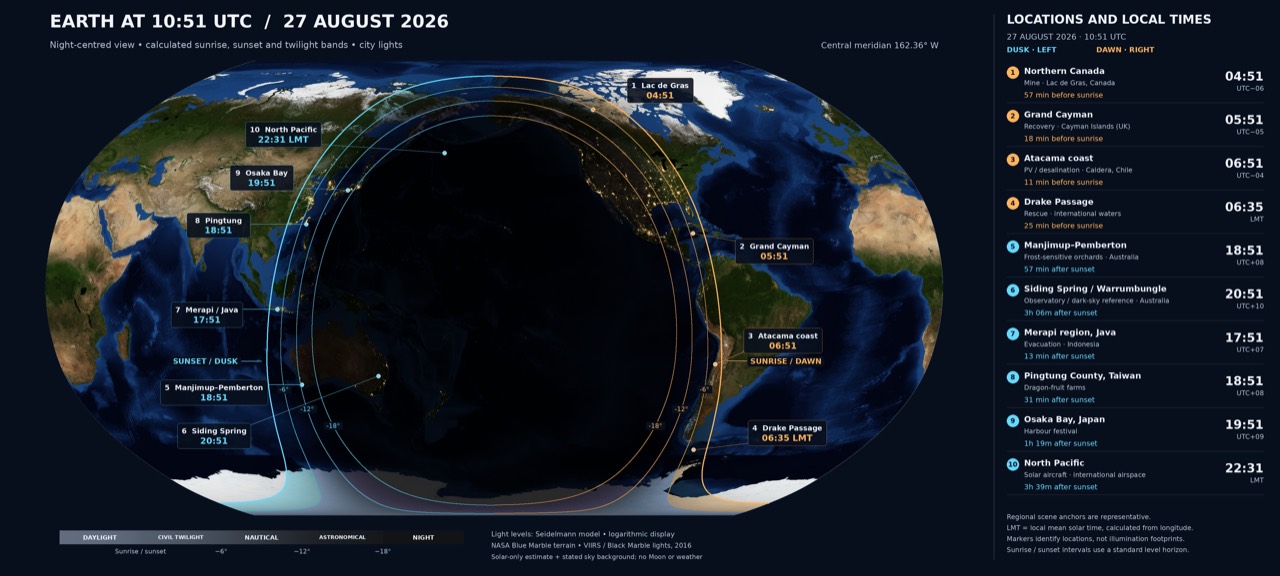
It is 10:51 UTC the 27th of August. The Pacific Rim of Fire is passing into the broad reaches of dawn and dusk where ~1.7 billion people are beginning or ending their day under the Sun. Miners start work, emergency crews restore communities after storms, utility workers produce freshwater and electricity, rescuers search the open ocean, orchard tenders protect fruit from frost, astronomers observe the cosmos, and families gather for the evening. Since our earliest use of fire, access to light has extended human safety, work, and community beyond the hours of day. On this morning and evening, some of that light is being called from tensioned mirrors in orbit, from orbital heliostats beyond the skies above.
At Gahcho Kué in northern Canada, sunrise is still fifty-seven minutes away. The morning shift has already worked for two hours and fifteen minutes beneath reflected sunlight. The mine’s operations centre called for enough light to meet safety thresholds across the airstrip, haul roads, and active work areas, but no more. Local lamps remain where precision requires them, the diesel lighting towers that once burned through the Arctic twilight stand dark, their fuel unspent and their emissions unreleased. Another hour and forty minutes are scheduled, long enough for the rising Sun to clear the surrounding terrain and take over the illumination of the site.
Southward, a hurricane has damaged Grand Cayman’s electrical grid. For one hour and thirty-five minutes, the island’s emergency operations centre has called sunlight onto its surviving solar arrays, keeping a hospital, communications network, and seawater desalination plant operating while preserving enough stored energy for forecast clouds and the following night. Restored lines are beginning to carry part of the load. The centre has chosen to continue service for another forty-eight minutes, adjusting the requested illumination as the grid recovers and the needs of patients and residents change.
Along Chile’s Atacama coast, a regional utility and water authority have scheduled a high-irradiance field of light, five kilometres wide, over a solar array. Thousands of mirrors overlap their reflections so that the panels receive a steady extension of day. For two hours, the added electricity has driven reverse-osmosis desalination and pumped freshwater inland to communities.
Because the plant’s own solar field now carries more of its load, wind generation can serve other towns and industries. Batteries needed less energy stored before nightfall because reflected sunlight would carry part of the dark interval. Gas and diesel generators have shut down before the night has ended, avoiding fuel whose price has continued to rise and emissions the region need not release. Another two hours and six minutes are scheduled, continuing through sunrise and into the cool morning while the panels can still use the additional light efficiently. Here, orbital sunlight does not displace wind, storage, or terrestrial solar. It allows each to do more useful work.
Farther south, a maritime rescue coordination centre has called for a five-kilometre field of light to move across the Drake Passage with its search grid. For two hours, it has revealed an expanse of ocean that aircraft lamps could sweep only narrowly and no ship close enough could illuminate in time. The centre has reserved continuous service until the survivors are found or dawn provides equal visibility. The orbital operator reports the service it can sustain, the rescue centre decides what the search requires.
Across the evening band, people tending fruit orchards in Manjimup-Pemberton, Western Australia, called for high-irradiance sunlight before sunset. For two hours and fifteen minutes, it has slowed the orchards’ loss of heat and reduced the fuel otherwise burned to protect the fruit from frost. Incoming fog will now weaken that benefit and scatter light beyond the boundary and intensity permitted for the service.
Their cooperative ends its request immediately, not a minute later. The orchards descend into twilight within seconds. Above them, the brilliant moving points contract into a line of faint stars as their membranes relax, then disappear together as the mirrors turn edge-on to the Sun.
Near Siding Spring Observatory in eastern Australia, a regional utility had scheduled orbital sunlight over a solar array only until the observing night began. The service ended as agreed one hour and forty-six minutes ago. Astronomers opened their instruments to the dark sky while wind and stored electricity carried the remaining demand.
In a neighbouring district, another utility requested late-night service near Warrumbungle’s protected dark-sky zone. The regional authority denied it before the first mirror turned. At that hour, only higher-orbit service remained, and its wider illuminated area would have entered the protected darkness. The energy system met the load through wind and storage instead. Light was available, the people responsible for that place chose not to call upon it.
Around Mount Merapi in Indonesia, families are moving downslope after an eruption disabled power along evacuation roads, shelters, pumping stations, and search sectors. The local disaster agency has scheduled a two-hour bridge of illumination, the time it expects to need to move exposed communities and establish generators and portable lights at the principal junctions and shelters. Ten minutes have passed, one hour and fifty minutes remain.
As the service window narrows, only the highest permitted orbits will remain, widening the minimum illuminated field toward eight kilometres. That broader field will cover the connected evacuation district rather than a single road. The disaster agency may release the service sooner if ground systems are ready. When orbital geometry closes the window, the generators and lamps below will carry the remainder of the night.
In Pingtung, Taiwan, a growers’ cooperative, with county approval, has scheduled a measured extension of day across participating dragon-fruit plots. Fifteen minutes have passed, two hours and fifteen minutes remain. One district-scale field of light replaces thousands of lamps, kilometres of temporary wiring, repeated maintenance, and a sharp evening demand on the local electrical grid.
During an earlier trial, a pointing error illuminated two plots beyond the approved boundary. Responsibility had been assigned before service began: the cooperative answered for the location it requested, the county for the land it authorized, and the provider for where its mirrors placed the light. Ground meters established the extent and duration of the spillover. The provider compensated the affected growers, and the county suspended further service until independent measurements confirmed that the failure had been corrected. Accountability preceded the error and remained part of the service after it.
In Osaka, the city has chosen orbital illumination for a harbour festival because its broad, even character resembles moonlight upon the sea more closely than light cast from towers. Lanterns and fixed lamps remain where navigation and public safety require precision. The approved waterfront has been illuminated for twenty-five minutes and will return to its ordinary night in another hour and thirty-five.
Farther northeast, an experimental solar-powered aircraft crossing the northern Pacific has climbed above the clouds to receive sunlight at night. After its batteries fell below the reserve needed to complete the planned mission, the flight team called for a moving corridor of orbital light. The aircraft’s state of registry authorized the experiment, the authority responsible for the oceanic flight-information region coordinated the corridor, and the states supervising the heliostat fleet authorized the orbital service.
For one hour and thirty-five minutes, a large fleet of mirrors has followed the aircraft, adding energy to its wings where no terrestrial grid can reach. The cloud deck below diffuses the light not captured by the aircraft before it reaches the ocean surface. At this latitude and season, the constellation can sustain the corridor from dusk until dawn. Another hour and ten minutes remain scheduled, though flight control will release the service as soon as the batteries regain the reserve needed to continue safely.
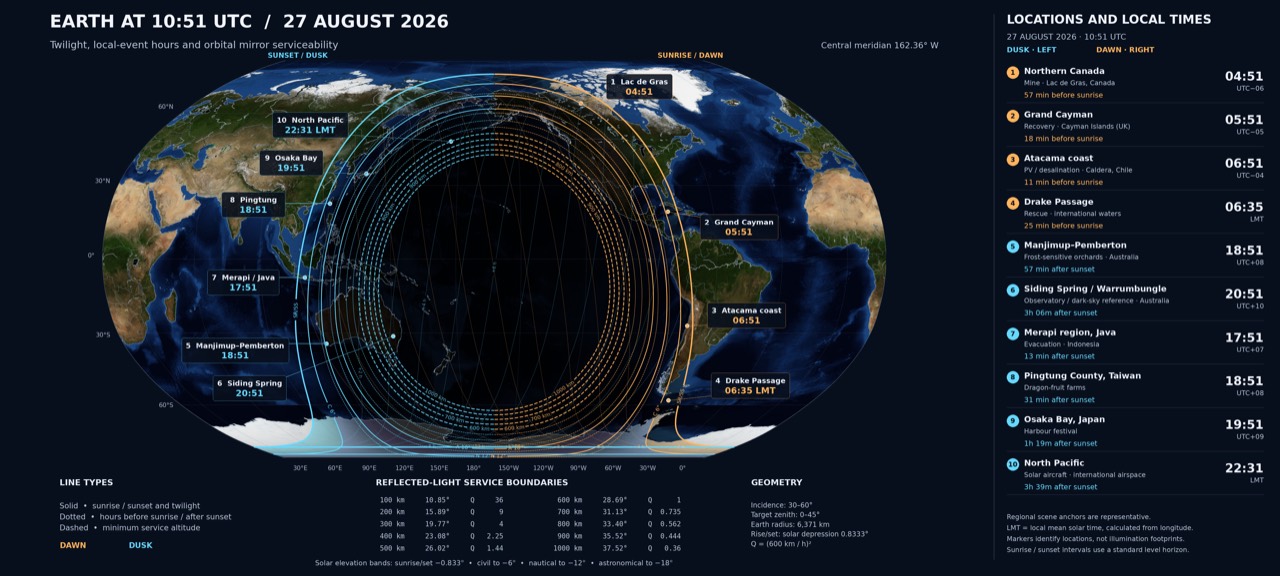
These scenes are imagined. They are neither a forecast nor a promise yet made on behalf of any service provider. They describe one possible future in which every orbital band carries part of a constellation, making light accessible wherever the Sun, the site, and the mirrors enter the necessary geometry.
Its arrival would follow a similar sequence at every site, though the number of mirrors and the intensity delivered would differ. At the appointed time, a procession of dim points would enter the twilight sky. As their membranes tension and their reflective surfaces turn toward the Sun and the requested place, each would brighten beyond every star and planet above it. Within its serving field, even one heliostat would raise illumination beyond that of the full Moon. Many could overlap their light into a continuous field, with no visible interruption as the procession crossed the sky.
No solid beam would descend from space. The intended landscape would simply gather light as if under the full moon. Roads would emerge. Water would acquire a pale horizon. Solar panels would return to production. Shadows would form beneath a moving, moonlike light.
Beyond the approved field, the directed reflection would reach no observer. The spacecraft would be designed to conceal their mirrors from the sun when not needed and remain in the shadow of the Earth outside their service hours. When those below released the service, the membranes would relax. The brilliant points would fall briefly to faint stars, turn edge-on to the Sun, and disappear even to the most sensitive telescopes. The land and water would return to the night they had left.
Fire taught an early form of the same lesson. Its value did not come from being harmless. It came from learning how to kindle it, contain it, extinguish it, and answer for what it touched. The reach is now greater, but the foundation behind the tools of stewardship remains the same.
In Western Australia, that responsibility comes down to a fence. The fruit still needs warmth when the fog rolls in. A grower standing in the last row can see what is about to happen. The light that has warmed these leaves will scatter into the next field. No one there asked for a longer day. At a word from the field, every mirror serving it must turn. That is the power we must secure for the stewards of the lands and seas our mirrors would reach.
An invitation from one field cannot speak for the next. Extra light can change when neighbouring plants flower and where insects feed. Night-flying moths carrying pollen between flowers also need the dark. Near Siding Spring, scattered light can brighten the sky and conceal the faint objects astronomers have waited to observe. These consequences belong in the decision alongside the warmth that protects the fruit and the electricity that keeps a hospital running.
If a service provider, a single customer, or an official who does not represent those affected holds that decision alone, the light can continue after those below need it to stop. A land steward may see light spill into the next field, or an astronomer see an observing night interrupted, yet have no means to turn the mirrors away. Those who know what is happening must be able to change what happens next.
We must keep the tools of stewardship in the hands of those who live with their effects. Let those tending the lands and seas call for useful light, measure where it falls, and end its use when conditions change. Let all who share its effects shape the decision before the first mirror turns. The power to bring sunlight must carry the power to protect darkness.
Those who tend the lands and seas must have the power to call for sunlight and to turn it away. Share where light could serve a place in your care, what its darkness sustains, and who must take part in the decision. Help put that knowledge into practice before the first mirrors turn.