This self-erecting, ultralight, deployable Geodesic Dome takes Buckminster Fuller’s ideas into the new Millenium. Desert Snowflake, the winner of the people’s votes, is an ode to architectural origami form. It showcases the value of flexible, lightweight yet highly-robust construction systems paramount for extraterrestrial colonisation. The spore-like structure has been designed with adaptability and modularity in mind, allowing for continued growth of the Martian colony in time.
Salazar is an expert of striking the perfect balance between art and science. A master of origami and an environmental studies student, he’s able to apply both his art and science skills to build solar reflectors for a project at NASA’s Jet Propulsion Laboratory (JPL).
The use of origami in engineering was largely driven by space exploration. While an intern, polymath Robert Salazar’s origami background informed his work on the NASA Starshade—an unfurling flower-like device designed to help block light from stars (starlight suppression) in order to better photograph their orbiting exoplanets.
… students here call him a genius … this is something out of Jurassic Park … and he’s rather amazing.
The artist, scientist, and activist, known for his intensely detailed origami works of art, has a lot going on besides folding paper.
I am very happy to see we again have an origamist of [his] caliber in our midst. What [he is] doing can be central to the kinds of systems we will be making in 20 yrs.
Complex work … his subject choices are quite clever
… their work on the navigation system for AstroAccess mission is insightful and fundamental, not only for space environment but for blind user accessibility everywhere.
Perhaps the most striking example is a bright-red cycad seed cone folded by Robert Salazar out of a single uncut hexagon of Thai unryu foil paper. Anyone who has visited the cycad garden will surely remember these eye-popping ornamental plants. The fact that Salazar was able to “sketch” such a beautiful and complex natural object in three dimensions simply by folding reflects a mind-boggling sophistication that is much in evidence throughout not only his work but also the entire show.
Salazar is a deployable structures contractor at NASA’s Jet Propulsion Laboratory (JPL) who is also a famed origami artist and environmental activist.
The Santa Barbara Maritime Museum will host origami artist and wildlife activist Robert Salazar, who will discuss origami’s metamorphic nature … Salazar will explore how harmony is readily accessible, even among origami’s thousands of complex interdependent folds (from a fraction of an inch to several feet long) that might inhabit a simple sheet of paper, to create something beautiful.
Starshade had a nontrivial problem of how to make the geometry and kinematics of the expanding ring truss match the kinematics of the baseline deployable origami pattern. The two elements packaged very nicely together, but were incongruent at their mechanical interface, with each preferring its own complex 3D motion through space. Most of the team assumed no solution could exist and that we’d need to implement an elaboration of stretchable fabric and cables to complete the system. However, Robert eagerly took on the challenge. After a few days of nonstop work and many prototypes, he had an elegant folding solution that mated perfectly with our scaled truss hardware. The two moved together in harmony during their deployment, and instantly won over all the doubters.
The artist and engineer behind the latest deployable Transformers for Lunar Extreme Environments designs
Beautiful origami crease patterns
His art shows how harmony can transform something as simple as a sheet of paper into endless possibilities.
Salazar is also a scientist and engineer whose mission is to promote peace, environmental sustainability, and exploration through his work.
… the Orisun team placed above the rest because they built a functional prototype on the day of presentation.
Robert Salazar, a JPL intern who designed the Starshade folding pattern, now works on an experimental concept called Transformers for Lunar Extreme Environments. … His own original designs include paper animals. In fact, he folds paper versions of endangered species and donates them to benefit wildlife conservancies.
Beautiful Japanese-like origami design
Robert’s story is much like his artwork. When he begins to fold a sheet of paper, it’s almost impossible to see the final piece. The final combination of all those creases throughout his journey has resulted in the groundbreaking work he’s doing now and his bright future yet to come.
Maybe more crucial for the potential success of the future prototype is Robert Salazar, the Heliostat Design Engineer. He worked on the design of the Starshade’s Optical Shield at NASA’s Jet Propulsion Laboratory; Robert went on to design ultralight deployable heliostats for the Transformers for Lunar Extreme Environments project.
JPL senior research scientist Adrian Stoica and Robert Salazar are working on a project known as Transformers For Extreme Environments. The project, initially revealed in 2013, will also incorporate ideas from origami to design unfolding mirrors. These mirrors will reflect the Sun’s light into deep craters on the Moon to melt ice and power machinery.
For the Transformers project, Salazar folds Kapton — a tinsel-like material used as spacecraft insulation — and a special polyethylene fabric that doesn't form permanent creases. Salazar works with JPL senior research scientist Adrian Stoica, who leads the Transformers project.
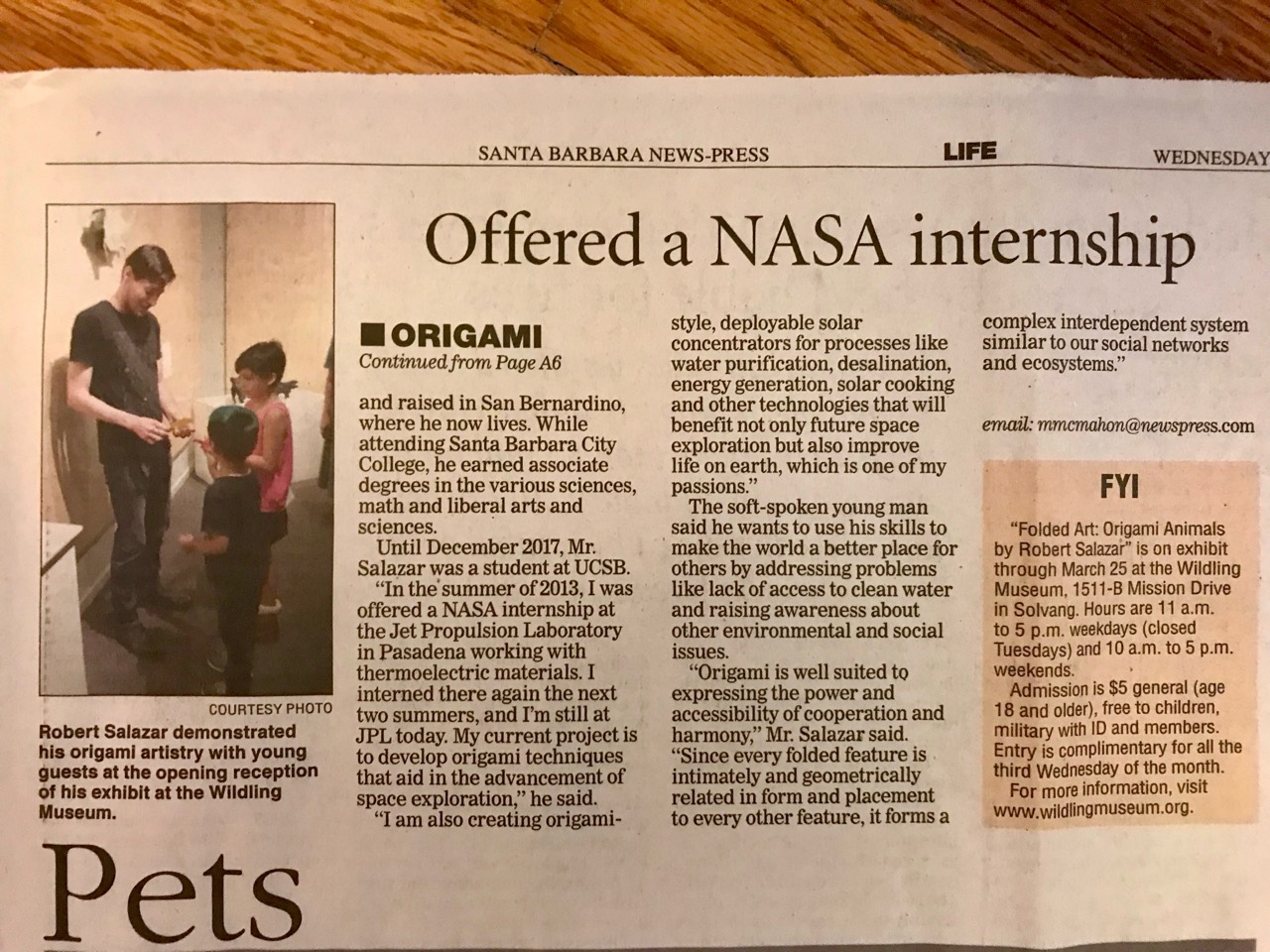
“Origami is well suited to expressing the power and accessibility of cooperation and harmony,” Mr. Salazar said.
His works range in size from a few millimeters to many meters across and can comprise thousands of folds.
In order to raise awareness for the protection of the last surviving Northern White Rhino, Robert Salazar makes amazing origami animals from Mulberry Paper.
In the current origami-inspired technologies being developed at NASA's Jet Propulsion Laboratory, there is a graceful beauty to the folding and unfolding of designs such as the Starshade, which unfurls into what looks like a sunflower. In origami, Salazar said, art, science and engineering are only superficially different.
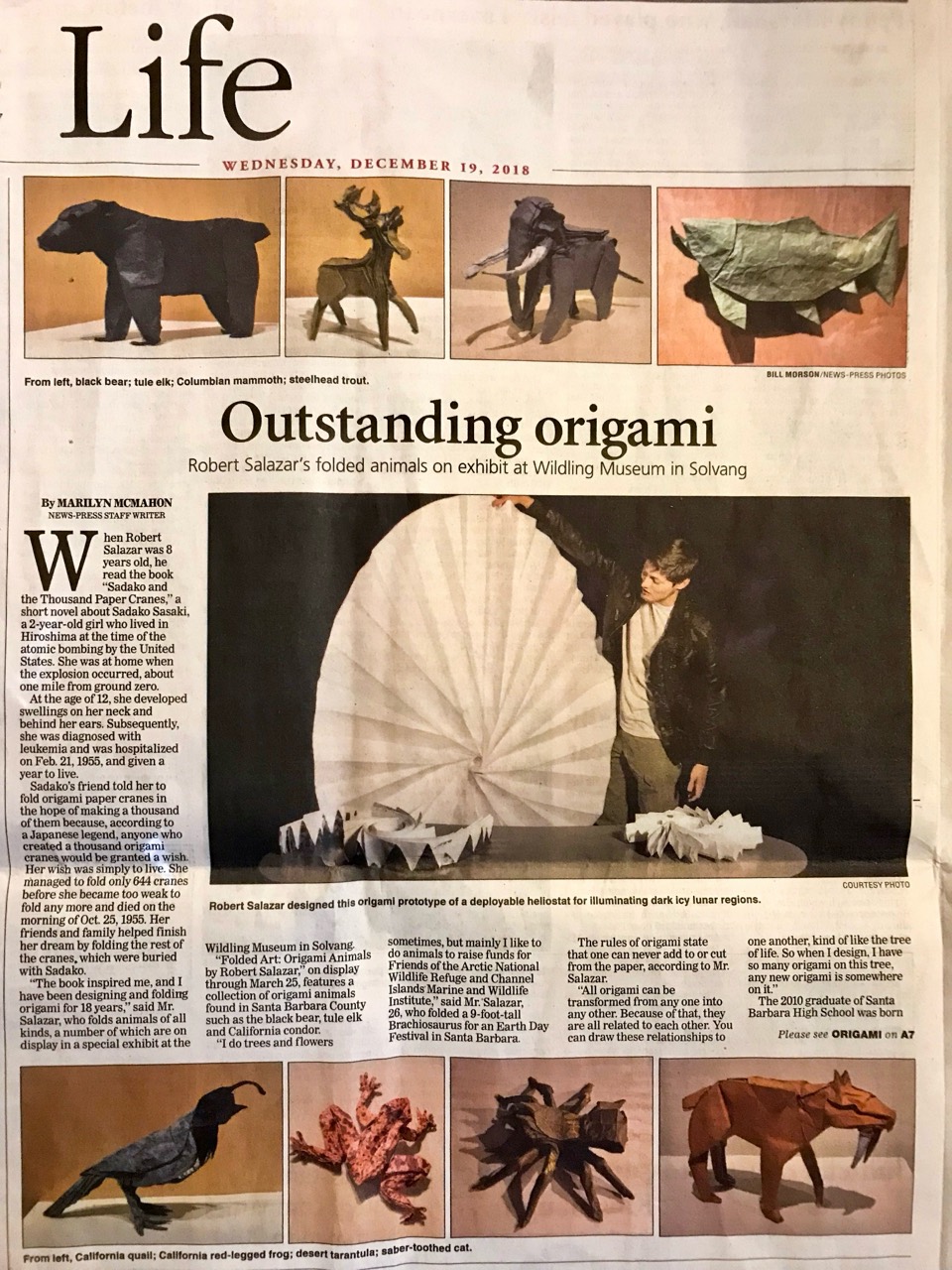
Robert Salazar said the book “Sadako and the Thousand Paper Cranes,” inspired him to take up origami.
The Santa Barbara City College student has created a 9-foot dinosaur similar to the ones seen in the movie Jurassic Park.
One City College student was chosen for a NASA summer internship to test and design nanomaterials that can cool detectors to just above -459 degrees Fahrenheit, to better capture high-quality images in space.
“He’s sort of a naturalist kind of guy,” said geology professor Jeff Meyer. “He’s … aggressively following these different paths [and] you’d think a person would be following just one of those paths but … not him.”
Researchers at University of California Santa Barbara say 20-year-old Robert Salazar could help modernize ultrasound machines, thanks to nanotechnology and a little curiosity involving an LED flashlight.
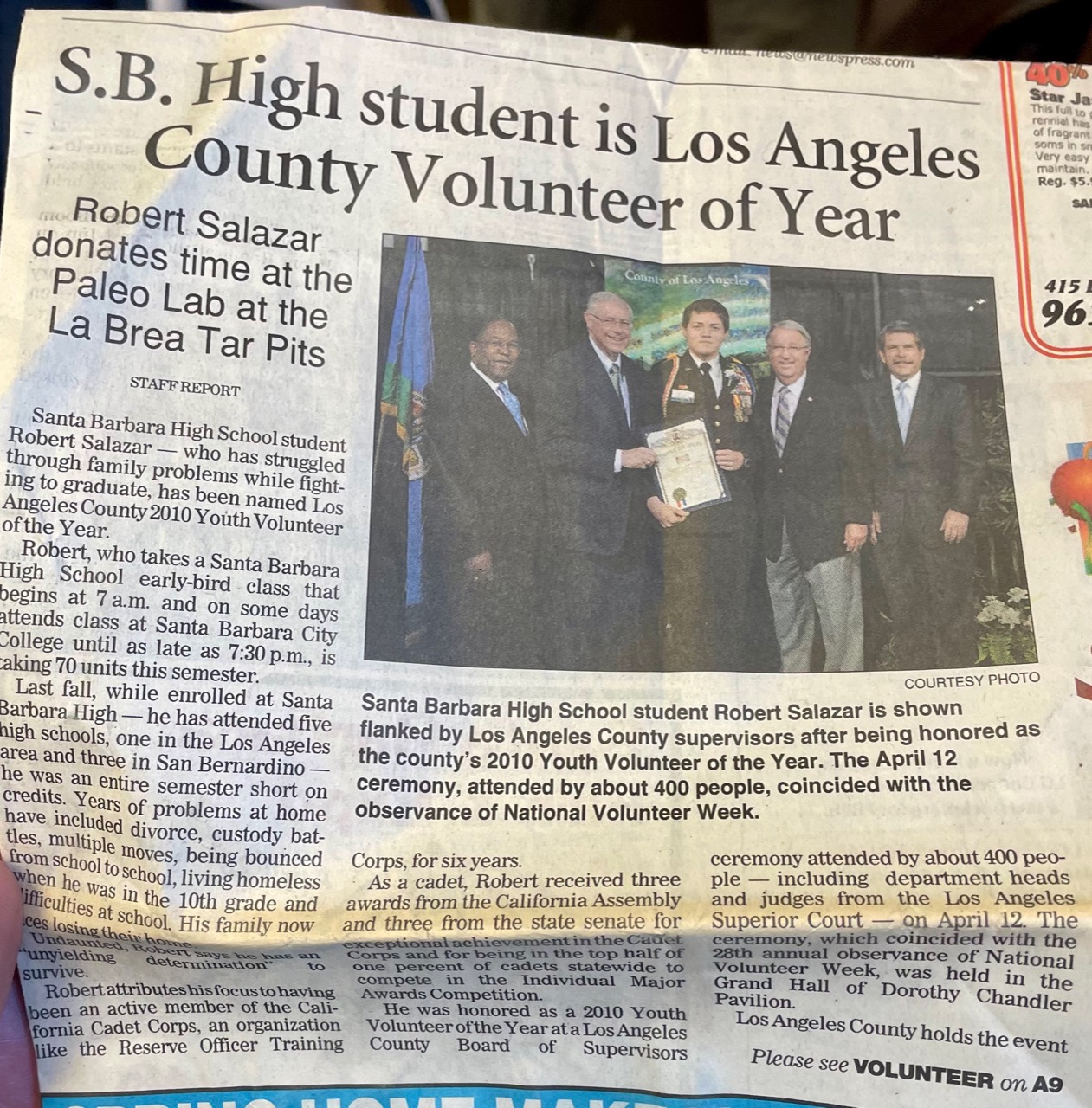
Robert is a remarkable young man who has made a real contribution to our efforts here at the Tar Pits. He is inquisitive, creative, and has an endless thirst for knowledge.
Robert Salazar donates time at the Paleo Lab at the La Brea Tar Pits.
· Marilyn McMahon
Robert Salazar’s folded animals on exhibit at California Museum of Art and Nature in Solvang.
· Staff Report
Robert Salazar donates time at the Paleo Lab at the La Brea Tar Pits.