
Beneath Europa’s ice, a change in temperature or chemistry could be a trail worth following. It might lead to material entering the ocean through the ice, to water altered by contact with rock, or to a place where chemical energy is available to life. Reaching the ocean would be an extraordinary beginning. Exploring it would mean finding where those relationships become visible.
NEREID proposed releasing small explorers from a melt probe at the ice–ocean boundary. They would expand in the surrounding water, communicate with one another and search for gradients. The primary mission would investigate the underside of the ice. A more ambitious extension would send gliders toward the seafloor, following clues through the water between those two frontiers.
Robert Salazar served as Co-Investigator and Science Principal Investigator, responsible for probe design and architecture, on the proposal led by Richard Archer. NEREID—Neo-ocean Exploratory Redox Integrated Delivery—advanced to the expanded Step B proposal stage of NASA Innovative Advanced Concepts. Its central design question was how to deliver enough capable explorers through a narrow passage in the ice to investigate the immense environment beyond it.
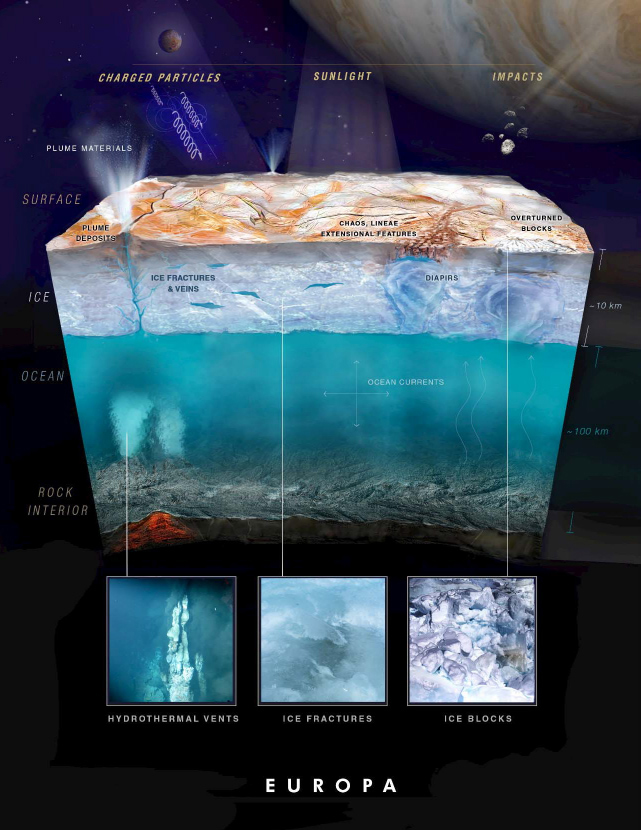
Europa offers a compelling meeting of water, chemistry and energy. Radiation acting on its surface produces oxidizing compounds. If that material reaches the ocean, it could encounter substances supplied by water interacting with the rocky interior. Some combinations could release energy through oxidation–reduction reactions. Finding where the ingredients meet, and how they are replenished, would help explain whether the ocean can support life. (NASA/JPL: Europa’s chemistry and energy)
A gradient is a change in a property across a distance. For an explorer, it offers both a measurement and a direction: toward warmer water, different salinity or a stronger chemical contrast. Following it could reveal the source of a nutrient supply or an energy supply. Finding little usable energy would also matter; it would change which places seem promising and where to investigate next.
The underside of the ice was NEREID’s first target. It would be accessible where the melt probe entered the ocean, and exchanges across that boundary could create scientifically valuable environments. If life exists, interfaces that bring materials together might support greater concentrations than open water. The mission would begin where access and scientific opportunity met. (Europa Clipper’s habitability science)
The seafloor offered a second, more distant frontier. Water–rock reactions and possible hydrothermal activity could supply heat and chemical resources to the ocean above. Jupiter’s tidal forcing contributes to Europa’s internal heating, but the activity of its seafloor remains uncertain. A probe reaching that boundary could begin connecting the ocean’s chemistry to the processes below it. (Research on Europa’s seafloor activity)
A body large enough to navigate open water is inconvenient cargo for an interplanetary journey and a narrow cryobot. Salazar considered deployable rigid structures, then pursued a way to form much of the body from a resource already at the destination: the ocean’s own water.
A compact quantity of hydrogel enclosed in a thin polymer membrane would hydrate after release. As it absorbed water, it would expand and tension the membrane into the intended shape. The hydrated interior would support the surface and its control surfaces. The probe could travel in a small package and acquire much of its working volume only when it arrived.
This was in-situ resource utilization applied to the explorer itself. The spacecraft would carry the membrane, instruments and other necessary hardware; local water would supply much of the deployed body’s mass and volume. The distinction mattered because every part brought from Earth competed for the limited capacity of the carrier.
The materials still had to work together in saline water. Swelling, membrane construction, component placement and the resulting shape all belonged to the same feasibility question. A structure that deployed successfully but could not steer or hold its sensors usefully would not serve the mission. NEREID treated the body, its surroundings and its scientific work as one architecture.
The carrier was envisioned as a VALKYRIE-style melt probe, or cryobot, maintaining a fiber-optic connection through the ice to a surface lander. Once it reached the ocean, it would become the local explorers’ base. Data relayed back to it could travel toward the surface and onward to Earth; its power supply could support recharging after excursions.
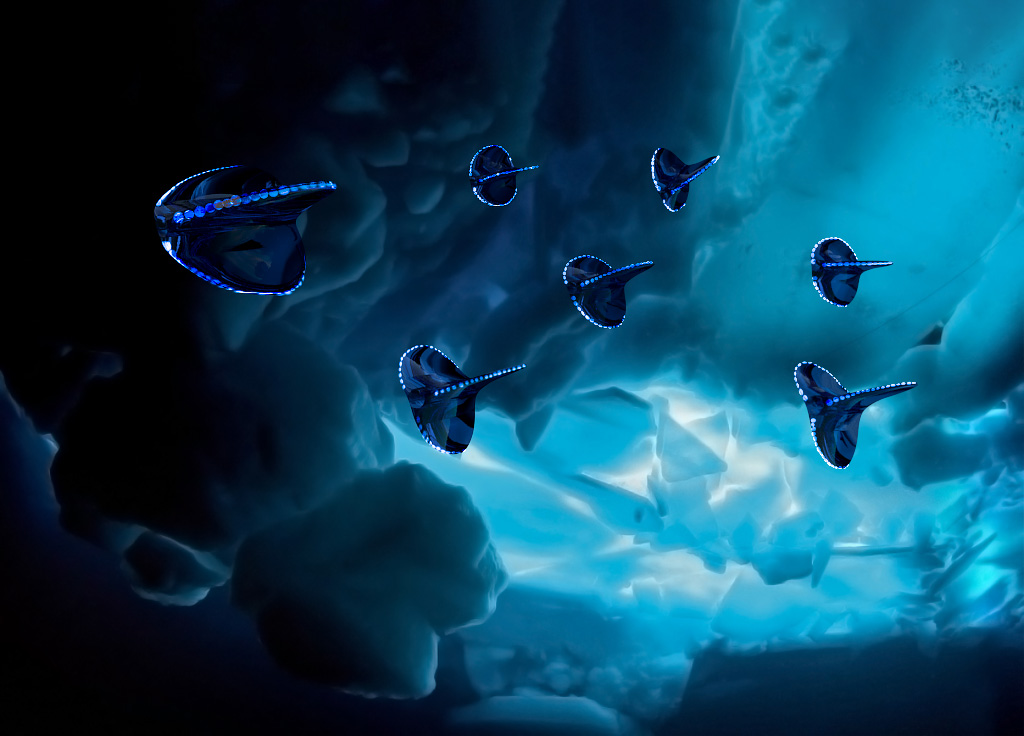
The local probes had ctenophore-inspired planforms and would be designed for neutral buoyancy. A motor would push water backward through the body to produce thrust, with movable surfaces directing the motion. After surveying near the ice, the probes would return to the cryobot for recharging. Their expanded bodies would provide useful surfaces for movement, sensing and communication without having to occupy that volume throughout transport.
Salazar also sought to avoid the mass of a protective pressure hull. The architecture selected and packaged components to operate at ambient ocean pressure, with electrical isolation addressed separately. This was an intended pressure-tolerant design, still requiring component and system testing. The aim was to spend the available mass and volume on exploration capability while accommodating the environment through the construction of the probe.
In the dark ocean, the explorers would communicate using blue laser diodes with lenses that spread the outgoing light. Amplitude modulation would carry data, and filtered photodiodes on their surfaces would receive it. Wavelength and detector choices would have to suit transmission through water. Each probe could pass findings through its neighbors toward the cryobot.
That connection also shaped the search. Signal strength was a requirement on where a probe could go: it would pursue gradients within the communicating cloud formed by the other explorers. A promising direction had to be considered together with the ability to bring observations back. The scientific reach of the mission depended on the relationships among vehicles.
The body’s shape participated in that network. In the three-finned local design, a Y-shaped cross-section exposed receiving surfaces in different directions and reduced self-shadowing. More light-sensitive area could be useful only if light from another probe could actually reach it. The same form had to serve swimming, packaging and communication.
The team considered collective search methods, including evolutionary approaches and particle-swarm optimization. The algorithms would need to pursue useful gradients while maintaining links and conserving power. These remained proposed research directions. The architecture defined what a successful search would have to respect; it did not establish a completed autonomous system.
Making a probe larger could give it more area to receive light and increase the distance between communicating neighbors. It would also leave room for fewer probes in the carrier. Salazar compared the reach of the delivered network to understand which effect mattered more.
A preliminary model in the December 2018 Step B draft compared 30 cm probes with probes twice as long. Under its assumed optical conditions and payload allocation, the smaller probes formed a much longer ideal relay chain. The larger receivers improved individual link spacing, but that improvement was outweighed by the reduction in the number carried.
Smaller was not a universal answer. Communication could consume a greater share of a small probe’s energy, reducing what remained for movement and sensing. The useful choice depended on how much ocean the network could investigate, for how long, and with what instruments. These calculations explored those relationships rather than selecting a final optimum.
The proposed measurements included temperature, pH, oxidation–reduction conditions, conductivity to assess salinity, and water clarity. Together they could reveal changes that a single sensor might leave ambiguous. Cameras, with white illumination used as needed, would add visual context to the places and materials encountered.
A gradient would guide investigation, but would not by itself establish life. Chemical energy can be available without being used biologically. Likewise, an intriguing shape in an image can have several explanations. The mission would need to bring environmental conditions, chemistry and observations of structure together to judge what it had found. (Life-detection science: combining evidence and context)
Even without finding life, tracing a chemical trail could transform our understanding of Europa. It could show where the ice exchanges material with the water, how nutrients enter the ocean, or how conditions at depth influence the water above. Those discoveries would give a future life search a map of processes and places worth examining more closely.
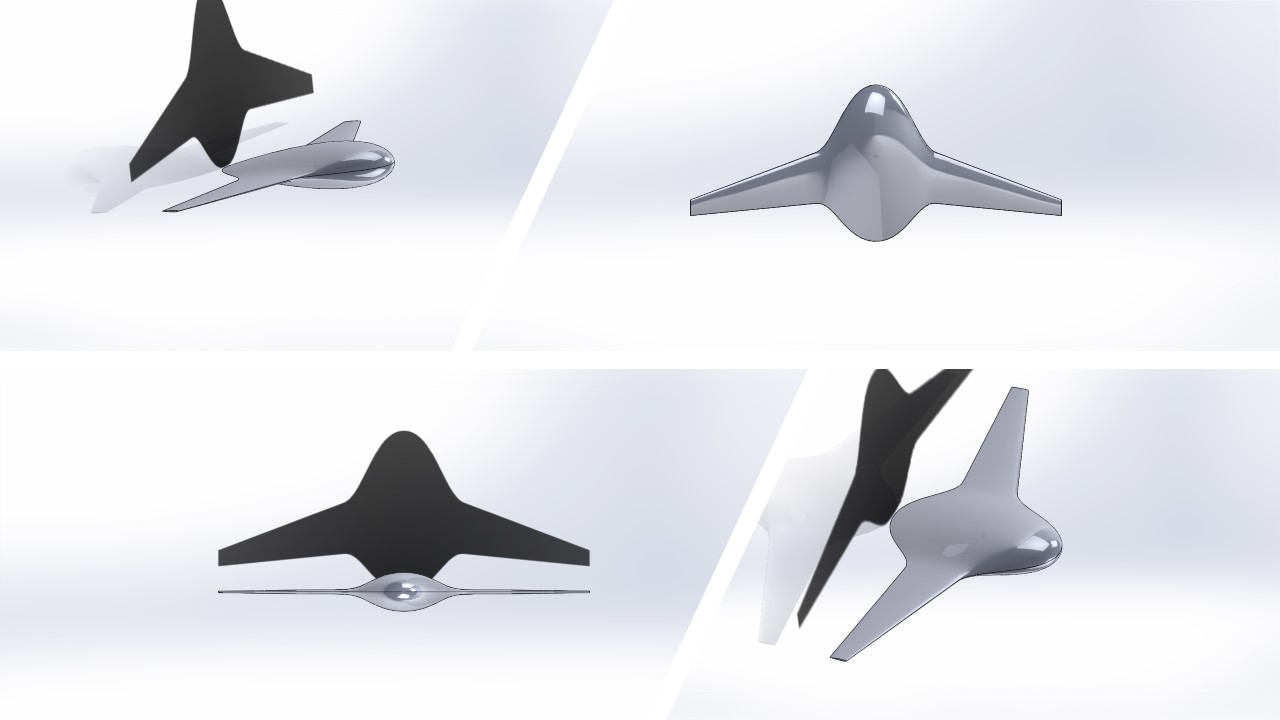
Beyond the local mission, Salazar designed a different explorer for the journey toward the seafloor: a blended-wing glider, also formed by hydrated material within a polymer membrane. It would follow gradients during a continuous descent, carrying instruments through environments the local swimmers could not reach.
The gliders would have slightly negative buoyancy. Their net weight would drive descent, their wings would convert part of that descent into forward travel, and actuated flaps would steer. They had no active propulsion. With a smaller energy budget, they would use stored electricity for sensing, communication and control while gravity supplied the motion.
Released sequentially, the gliders would form a branching network below the cryobot. They would search within that connected cloud and relay observations upward. The architecture provided a finite opportunity to report from depth: a glider on the seafloor would continue relaying until the last released glider lost contact with the cryobot. Release timing, optical range and descent behavior would therefore be central to assessing whether the extended mission could reach and report from its target.
The cold and pressure expected at depth motivated alternatives to the rechargeable electrical stores considered for the local probes. One concept stored mechanical energy in tensioned carbon fibers wrapped around a drum. Their gradual contraction would turn a shaft and drive an electrical generator through a high gear ratio.
Another candidate used a pressure difference. Water admitted gradually into an evacuated vessel would drive a miniature Pelton wheel and generator. The vessel’s role was to store usable energy by maintaining that difference; it was not a pressure hull protecting the instruments. The surrounding ocean could participate in power delivery as well as in forming the body.
These were candidate systems within the architecture study, with capacities and integrated performance still to be established. Their purpose was to make an extended descent possible within a small mass and volume allocation. Keeping propulsion out of the glider’s power budget left more of that allocation available for observing the ocean and transmitting what it found.
NEREID advanced to NIAC’s invitation-only Step B stage following acceptance of its initial proposal in 2017. The surviving design records span 2017 and 2018. The work remained a mission proposal; it was not a funded NIAC Phase I study. (NASA: NIAC selection statistics)
Its contribution was an exploration architecture supported by candidate designs and preliminary calculations. The next work would have needed to establish reliable deployment in saline water, component behavior under the intended conditions, usable optical links and a search strategy that could preserve them. Each test would have informed the others: the body affected the link, the link affected the search, and the search determined what the mission could discover.
The ocean was central to the means of reaching those discoveries. Its water could form the probes, its optical properties would set their spacing, and its gradients would offer directions to investigate. NEREID connected those relationships to a route from compact cargo to a community of explorers. At the far end of that route was the possibility of watching an unfamiliar ocean at work—and learning whether life had found a place within it.
Richard Archer
Principal Investigator.
Robert Salazar
Co-Investigator and Science Principal Investigator; probe design and architecture.
Dr. Rosalba Bonaccorsi
Subject-matter expert for the search for life.
Pia Sen
Subject-matter expert for search algorithms.
The 2017 proposal also lists Christopher McKay, Mariam Masoumi, Brian Kosmicki and Megan Brown as coauthors. This account draws on Robert Salazar’s recollections, the original Step A proposal, the robotics overview, the early mass-and-volume calculations and the December 2018 Step B draft.