
A canyon wall on Mars may expose the history of water in its layers. A fracture on an icy moon may hold material carried up from an ocean below. Seeing such a place from orbit is the beginning of an investigation. Reaching it with instruments could let us examine what the material is, how it arrived, and what it reveals about the world beneath our feet.
Adrian Stoica, a group supervisor at NASA’s Jet Propulsion Laboratory, posed a challenge: how could a rover navigate the adverse terrain separating a landing site from places like these? Robert Salazar took on the challenge and led a JPL-funded exploratory study beginning in October 2017. Its ambitions included both reaching otherwise inaccessible sites and taking shorter routes to destinations that would demand long detours.
The resulting concept, Solfugibot, combined six walking legs with two more articulated forelimbs for tools and instruments. Its long limbs could fold and contract for transport, then spread into a much larger working space. Making that reach useful meant reconsidering the relationships among the rover’s structure, its source of power, and the movements each limb needed to perform.

Concept rendering of the proposed rover exploring rocky terrain. The study developed component prototypes toward this larger objective.
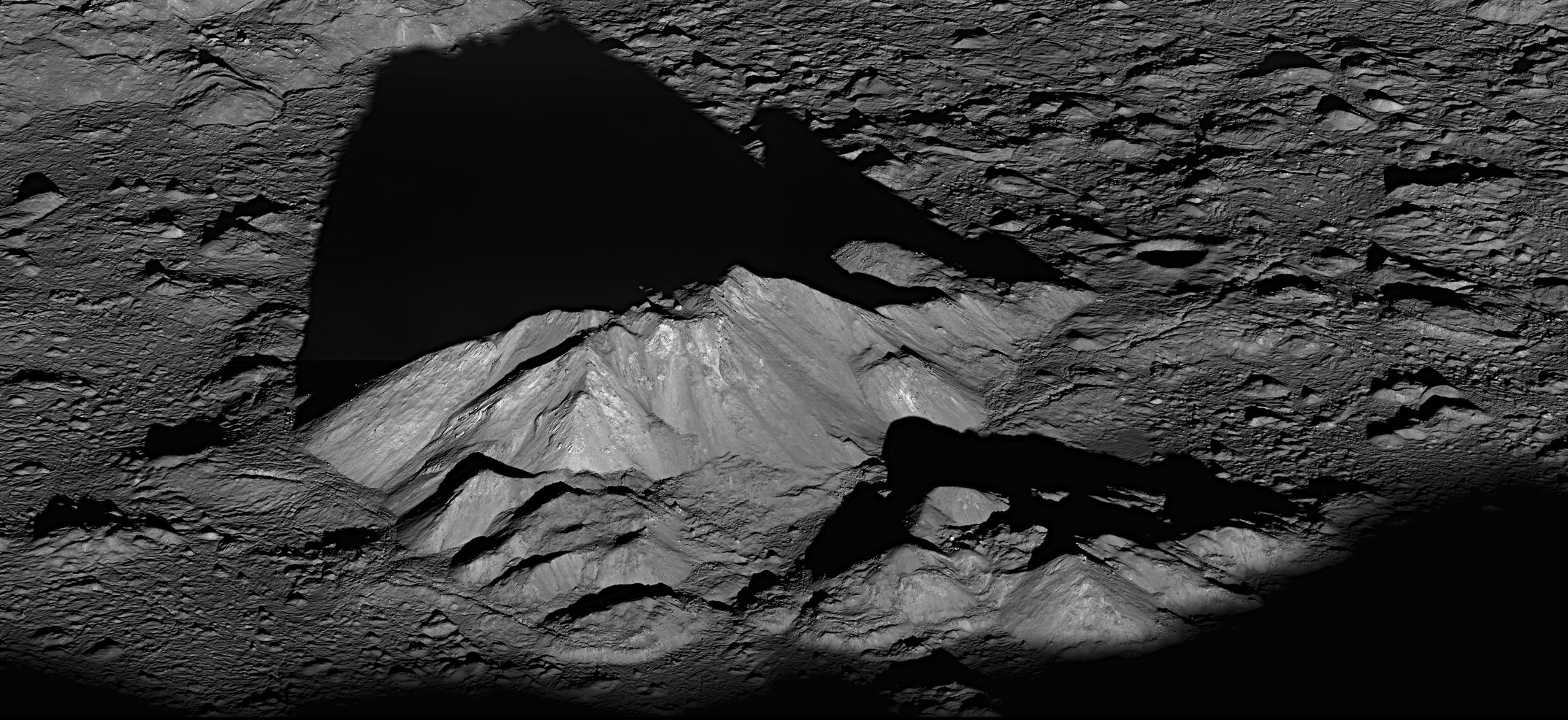
1 of 6 · Earth’s moon
An impact crater is an excavation into the Moon’s past. Its broken slopes, terraces, and boulders expose rock displaced and transformed by the collision. Reaching selected outcrops could help reconstruct both the impact and the crust it uncovered. A sample gains meaning from its setting: which layer it came from, what surrounds it, and how those pieces fit together.
NASA: lunar crater geology
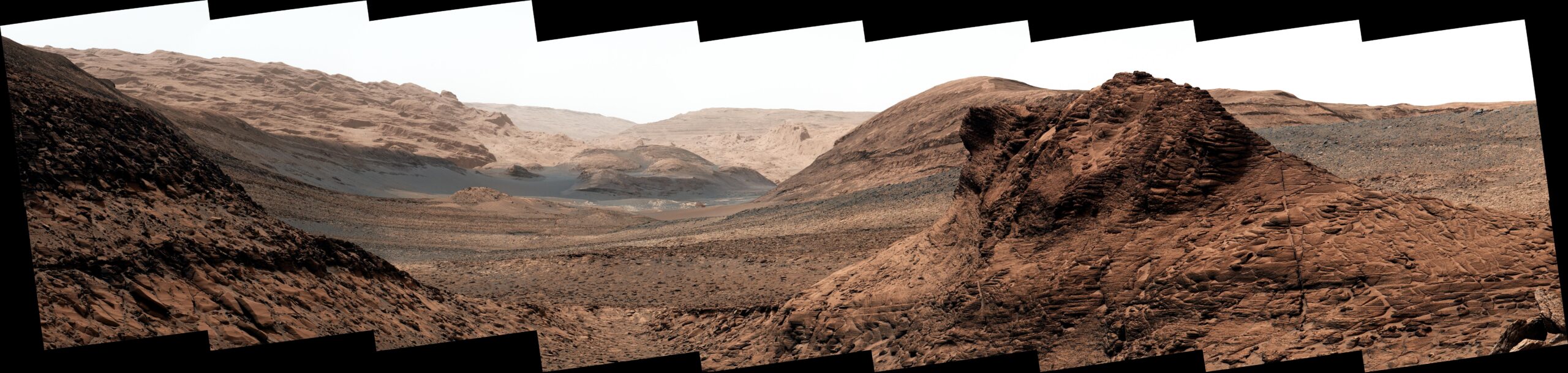
2 of 6 · Fourth planet from the Sun
On Mars, another band of exposed rock can be another chapter in the history of water. Curiosity has investigated clay-rich deposits and sulfate-bearing rocks that record changing environments. Reaching further into steep slopes and canyons could help establish when water was present, how its chemistry changed, and how long conditions favorable to life endured. The reward for crossing difficult ground would be a closer reading of that history.
NASA: the record of water on Mars
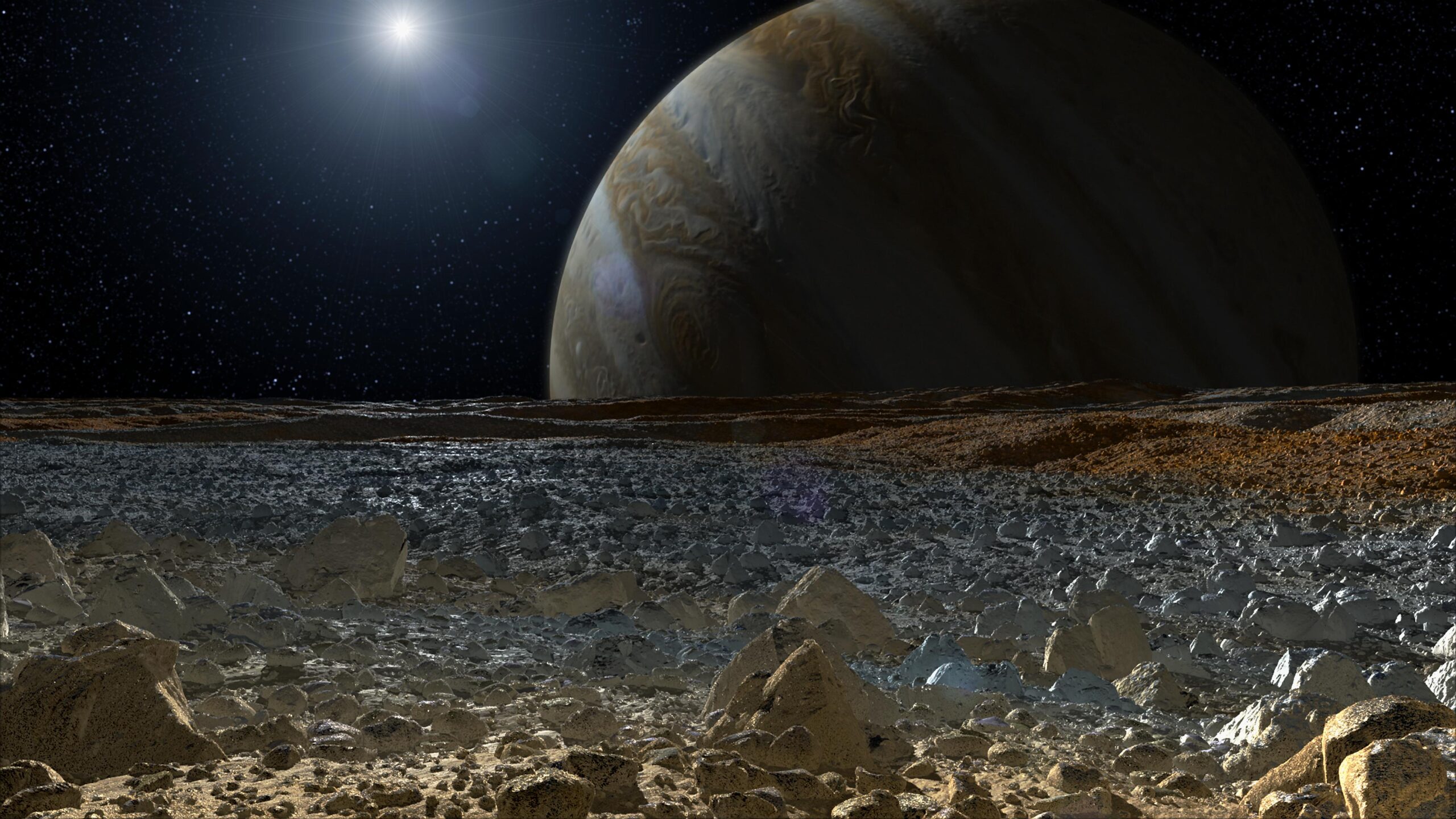
3 of 6 · Moon of Jupiter
Europa’s ridges and disrupted ice raise a compelling question: what passes between the surface and the ocean beneath it? Some non-ice deposits may contain salts brought from below. Reaching a particular fracture, displaced block, or deposit could connect a chemical measurement to the process that placed it there—helping reveal how the ice shell exchanges material with the interior and what that material says about the ocean.
NASA: Europa’s frozen surface
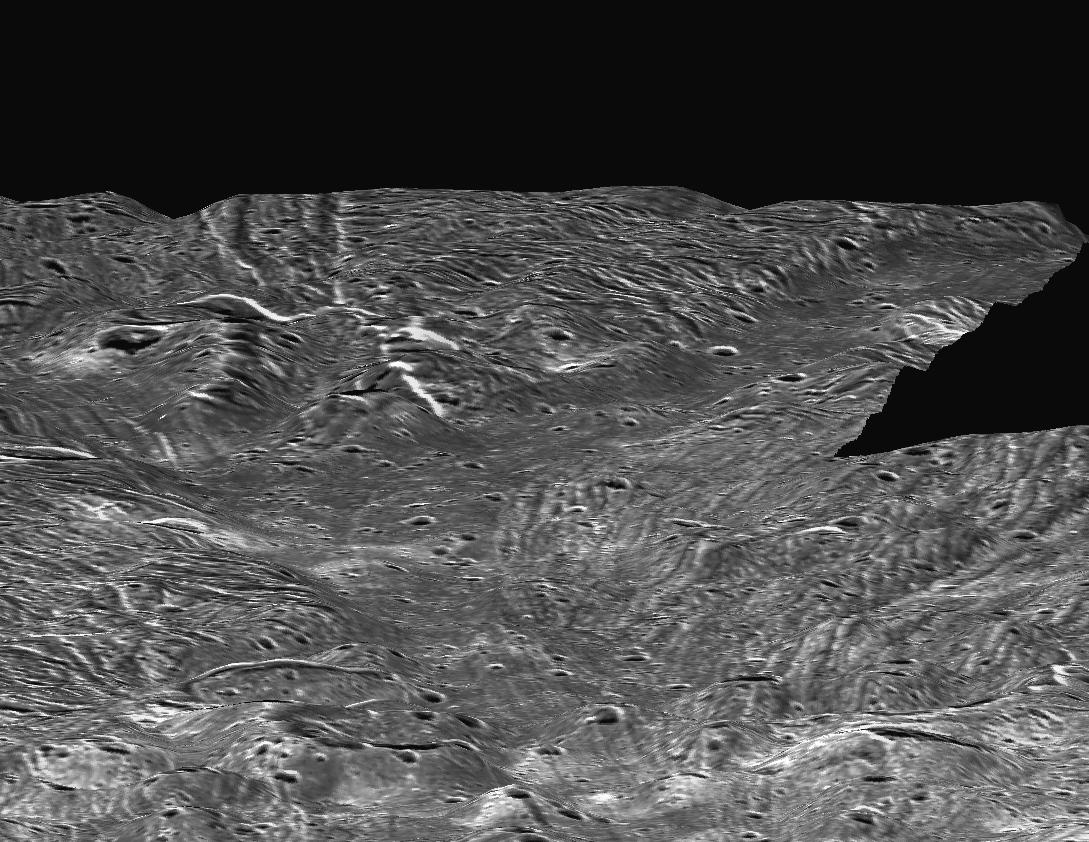
4 of 6 · Moon of Jupiter
Ganymede preserves contrasting landscapes: ancient cratered regions beside younger expanses of grooves and ridges. Exploring their boundaries could help reconstruct how the icy crust stretched, fractured, and changed through time. A rover able to cross interrupted ground could investigate the transitions that reveal how one landscape gave way to another, adding detail to the history of the Solar System’s largest moon.
JPL: Ganymede’s geological history
5 of 6 · Moon of Saturn
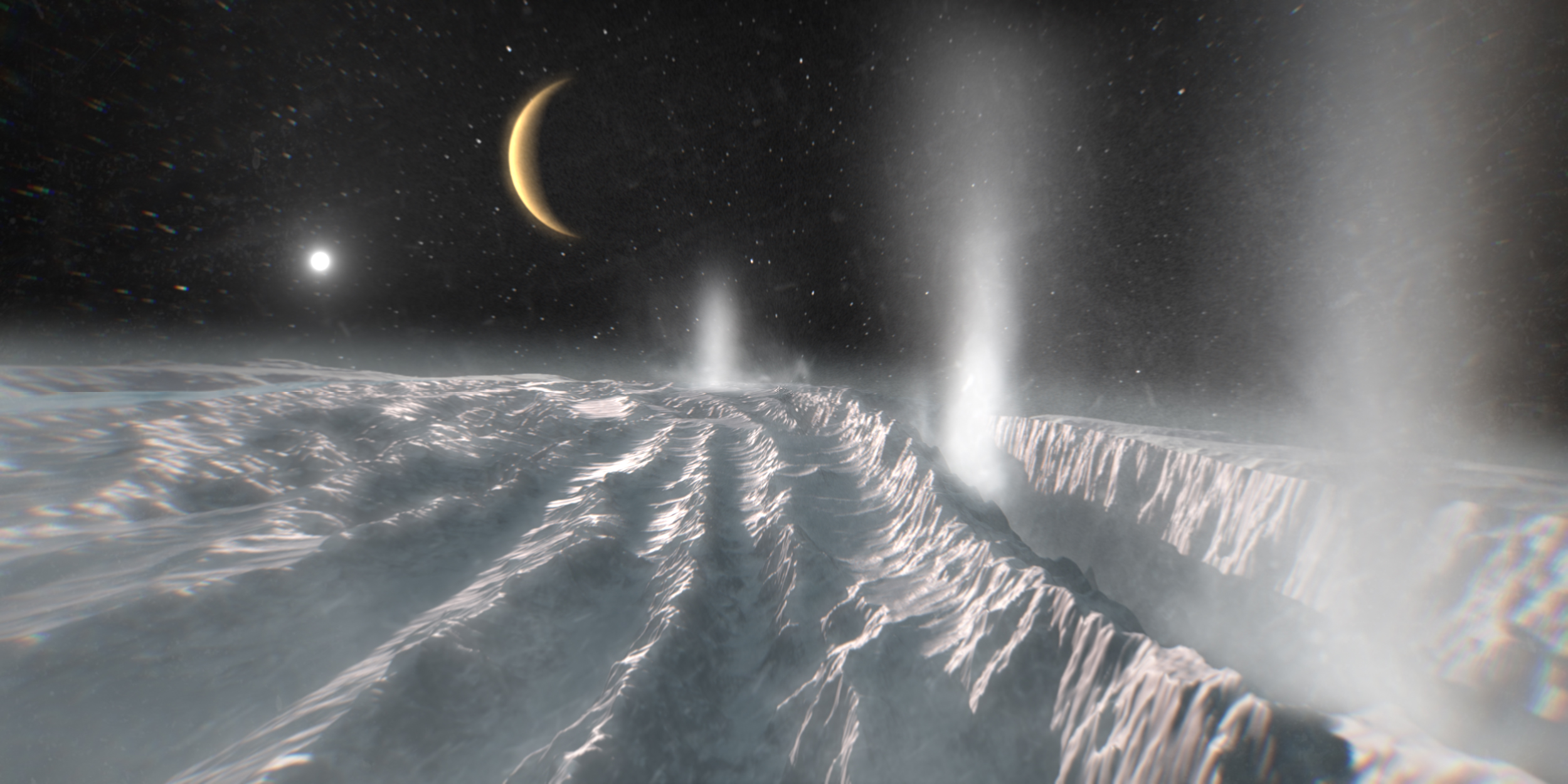
Enceladus brings an ocean within reach of the surface. Cassini found that its subsurface ocean feeds plumes of water vapor and ice, some of which falls back onto a landscape of fractures and large ice boulders. Investigating those deposits could reveal variations in ocean-derived chemistry and evidence of water–rock interactions. Carefully chosen measurements could help assess the conditions that make this small moon a compelling place to search for habitability.
NASA: Cassini’s discoveries at Enceladus
6 of 6 · Moon of Saturn
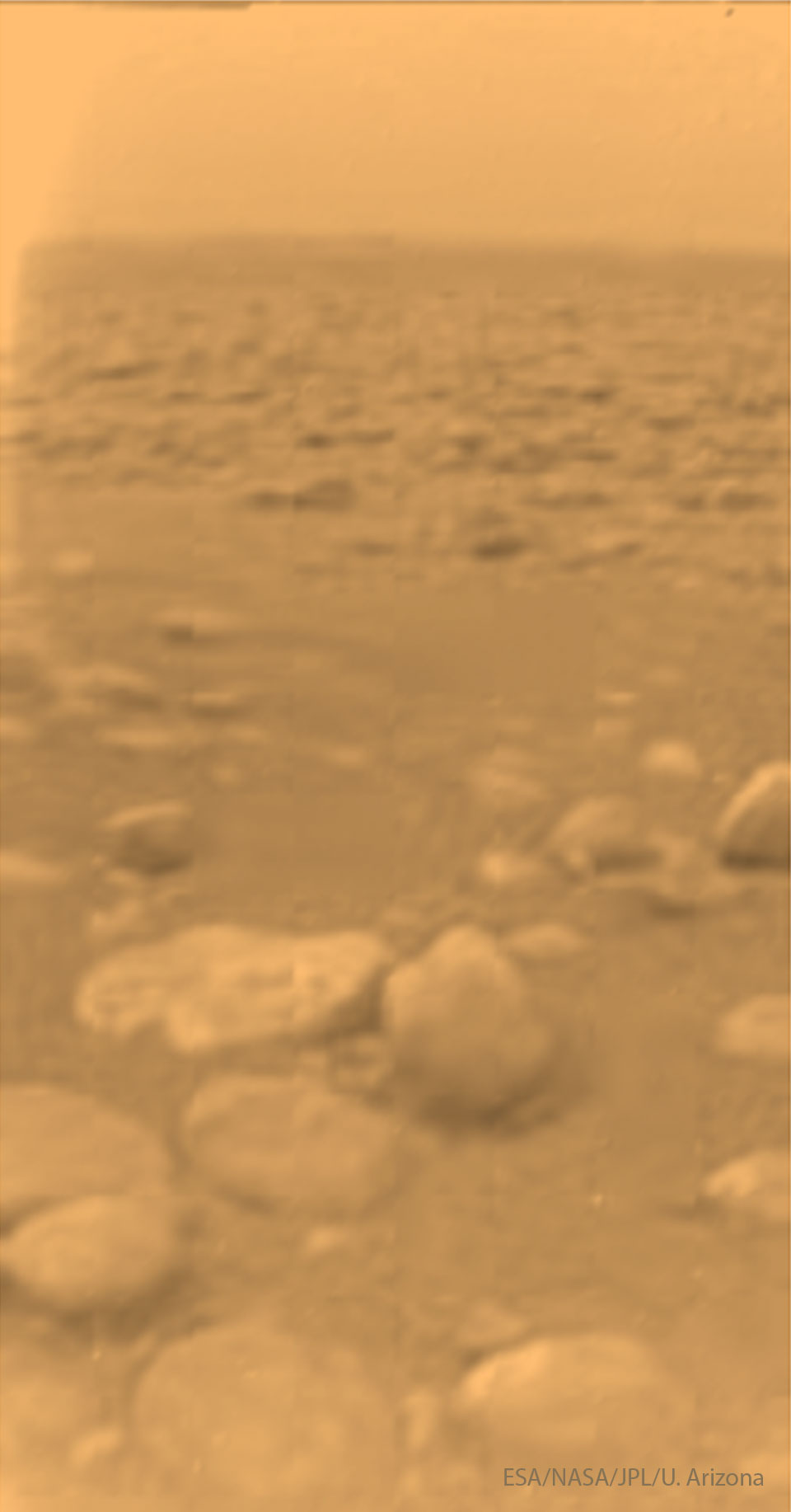
Methane rain feeds channels and lakes on Titan, where water ice forms bedrock and organic compounds settle from a thick atmosphere. Huygens’ images of branching channels and rounded pebbles revealed a landscape shaped by flowing liquid. Reaching channel banks, eroded slopes, and deposits could help explain how that flow transports and concentrates organic material. Comparing those places would connect chemistry in the sky with chemistry on the ground, on a world profoundly different from Earth.
NASA: Titan’s landscape and chemistry · NASA: Huygens’ views of Titan
Fields of penitentes—blade-like ice formations—were part of Stoica’s original mission conception for Europa and Enceladus. Their presence on those moons remains unconfirmed, but the possibility posed a vivid design problem: how could an explorer find support among sharp, closely spaced obstacles while keeping its body clear of them? (Research on possible penitentes on Europa; Subsequent assessment of their formation)
The terrain in this carousel illustrates the scientific promise of greater access. A future mission would need a rover and instrument payload developed for its particular destination. The shared ambition is to reach the places where a world’s history and chemistry can be examined directly.
A rover built to stride across large obstacles must first fit inside the spacecraft that takes it there. Solfugibot’s limbs combined folding with telescopic extension: three major segments folded against one another, and each segment contained three sections that could extend to three times its contracted length.
Together, these transformations gave a complete limb up to nine times the length of its fully folded and contracted state. The full-limb prototypes demonstrated that range. Reducing stowed volume opened the possibility of delivering a large walking machine in a small package; reducing the mass of both limbs and body served the same interplanetary transport budget.
Extension would remain useful after arrival. One leg could reach across a gap while another shortened to meet higher ground. Adjusting individual limb lengths during walking was intended to help keep the body and working forelimbs steady. Compact deployment and an adaptable stance could come from the same mechanism.
Folded polymer-sheet covers were also designed and prototyped. Each cover expanded with an individual telescoping segment, protecting the extending structure from debris while occupying little space when contracted.

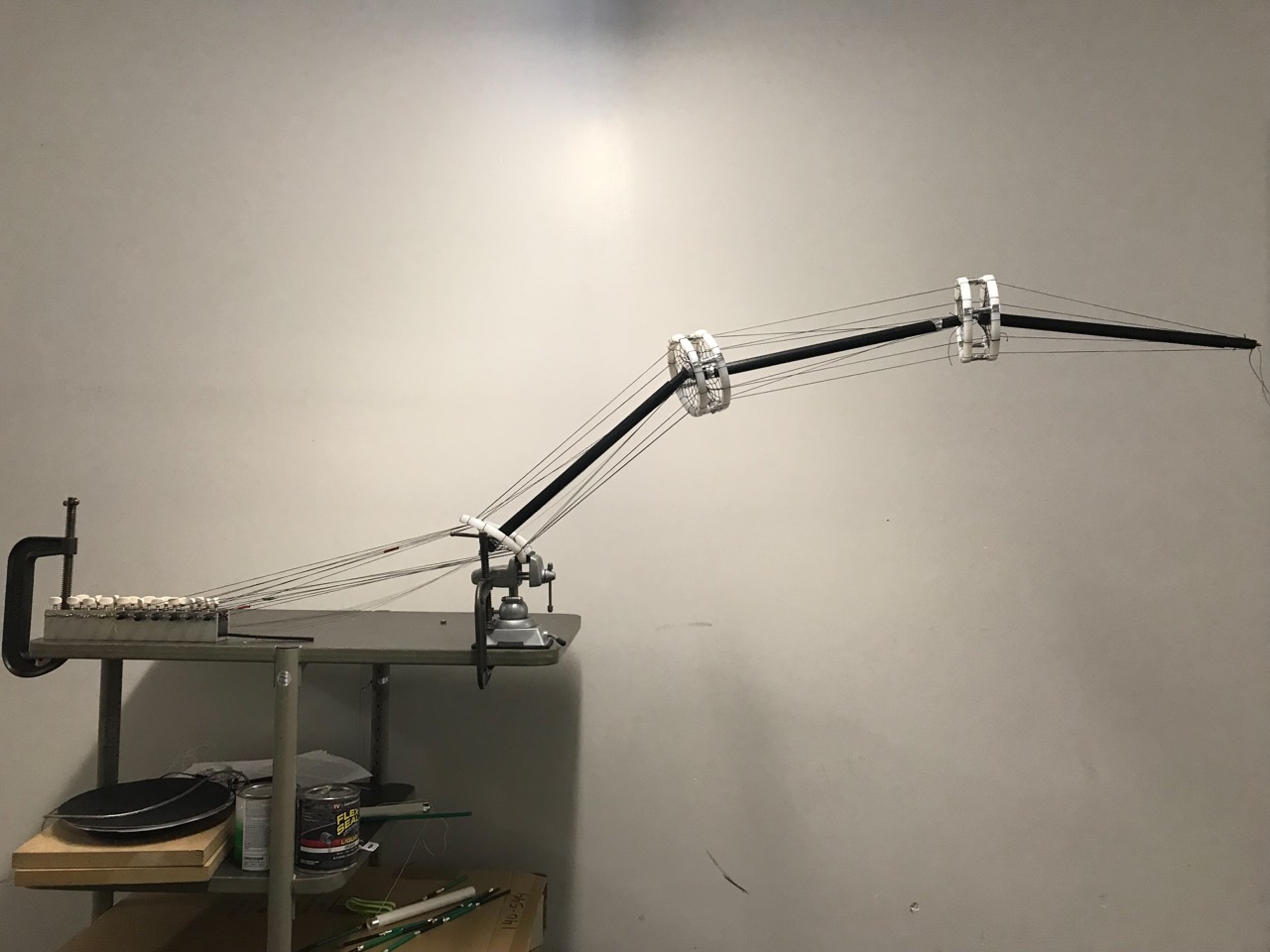
Partially extended forelimb prototype, showing its three major segments.

A single major limb segment with its folded-polymer cover, fully contracted above and partially extended below. The photographs are uniformly scaled to match the basal white rings and aligned at their centers; camera perspective differs.
Length alone would not make a useful explorer. A motor carried far out along a leg adds to the torque required to swing it. Repeat that hardware across the rover, and the machinery for moving the limbs becomes a substantial part of what must be moved. Salazar’s approach was to concentrate motors and clutches in the body and make the limbs themselves ultralight.
This reduced both the rotational inertia of the limbs—their resistance to changes in rotational motion—and the turning moments produced by their own weight. Low gravity would ease the weight penalty, but the limbs would still have to be accelerated and stopped. Keeping their mass low made extensive reach more compatible with the torque and energy available from a compact body. Savings repeated across several limbs could affect the whole machine. (Robot dynamics: inertia and joint torque)
The forelimb structure pursued the same aim through its load paths. Telescoping members carried compression; tensioned cords supported and actuated them. Designing those members for axial tension or compression made better use of material strength for their mass than requiring them also to resist bending and torsion. The compression members and cord network depended on one another to form a lightweight limb.
Joint geometry offered another way to improve the balance. Wider joints increased the lever arm through which a cord could turn a limb, while pulley arrangements offered further mechanical advantage. Those advantages had to be reconciled with the space available for stowage. The rover would still need to carry its body and withstand forces from the ground; the design reduced the cost of moving the long limbs themselves.
Moving the motors into the body changed how motion had to reach the limbs. The proposed transmission used two motors, arranged for redundancy, to drive a system of spools. Independently actuated clutches selected which spools received power. Cords carried their motion outward to the joints and extending segments, leaving both motors and clutches in the body.
The source of power was shared, while the movements could be selected individually. A commanded limb position would engage the appropriate spools, with sensor feedback guiding the result. This economy of hardware made coordination more important: the shared drive, clutch selection, and cord motion had to work together to produce the requested movement.
As a limb extended, some spools paid out cord to accommodate its growing length while others took up cord to drive the extension. A small opposing force between the sets kept the lines tensioned. High-modulus cords resisted stretch, helping preserve the relationship between spool movement and limb position.
The worm gearing also served the moments when the rover would stop. In the selected transmission, it prevented the spools from back-driving the motors, allowing position holding without continuous motor power or a separate locking action each time motion ceased. The same mechanism that moved a limb could help hold a stance while an instrument made its observation.
The eight-limb layout emerged during development. The first concept had six limbs of one design, each with two degrees of freedom at every joint. Salazar then developed a distinct walking-limb design that retained extension and walking with fewer joint freedoms. Its basal joint, where the limb met the body, retained two; each of the other two joints had one.
The original, more articulated design still offered something valuable: the ability to position an instrument or gripper. Combining six new walking legs with two of those original limbs at the front concentrated greater flexibility where it could serve scientific work, while reducing the actuation demands repeated across the walking legs.
The forelimbs could be fitted with scientific instruments, sensors, or end effectors such as grippers developed at JPL. They could approach a surface for measurement or provide extra grip on especially difficult ground. Degrees of freedom, abbreviated DOF below, describe the independent ways the limb geometry can change; they do not count its motors.
| Feature | Walking leg | Front limb |
|---|---|---|
| Basal joint at the body | 2 DOF | 2 DOF |
| Each of the other two joints | 1 DOF | 2 DOF |
| Extension of each major segment | 1 DOF | 1 DOF |
| Total per limb | 7 DOF | 9 DOF |
DOF = degrees of freedom. Totals include the basal joint, the other two joints, and one extension DOF in each of the three major segments. These are geometric freedoms; the shared drive determines how powered movements are coordinated.

Earlier six-limbed concept, before the two limb designs were combined in the eight-limb planform. The height labels describe the illustrated rover poses; the ninefold ratio compares the folded and extended length of a whole limb.
The division of work between walking and investigation found a biological counterpart in the solfugid. A planform used to navigate Earth’s deserts could suggest how to explore the deserts of Mars: keep the body moving across difficult ground while front appendages sense and engage with what lies ahead.
Solfugids have four pairs of legs. The three rear pairs perform locomotion, while the first pair serves a sensory role. Researchers studying the sand-adapted Galeodes granti observed the six rear legs moving in alternating sets of three. Solfugibot’s intended gait followed a similar support strategy: establish three contacts before transferring weight to another three ahead. Variable limb lengths would enlarge the choice of footholds among blocks, on slopes, or across possible penitentes. (Research: locomotion and sensory legs; Galeodes granti gait study)
The animal also carries a separate pair of leg-like pedipalps ahead of its legs. These sensory appendages can grasp prey and assist climbing through adhesive organs at their tips. Solfugibot adapted this combination of sensing, handling, and travel: its walking legs would support and advance the body while the more articulated forelimbs investigated a target or helped secure a difficult passage. (Research: sensory pedipalps; Adhesive organs in prey capture and climbing)

A desert solfugid—the biological inspiration for a rover intended to reach difficult ground on other worlds. Image supplied by Robert Salazar.
Long-legged harvestmen offer a complementary lesson. Their slender legs give a small body a wide reach while carrying relatively little mass. For Solfugibot, similar proportions made sense because lighter long limbs demand less torque to accelerate and to support their own weight. The biological comparison concerns that economy of reach; the rover achieved it through its own system of structural members, cords, and body-mounted drive hardware. (Research: harvestman proportions and locomotion)

A harvestman’s slender legs give a compact body a wide reach—a biological comparison for Solfugibot’s long, lightweight limbs. Image supplied by Robert Salazar.
The exploratory study built and tested the mechanisms on which that larger vision depended. Salazar made manually extending and articulating limbs, including the three-major-segment forelimb shown below. The full-limb prototypes demonstrated the ninefold change from folded and contracted to unfolded and extended, and held their positions well.
Aaron Nguyen developed an electronically actuated limb-segment setup. Joystick commands spooled and unspooled cords to change its position, with sensor feedback supporting control. The test fixture used individually driven spools to investigate cable actuation; it was a separate demonstration from the proposed two-motor shared transmission.
Savannah Cofer completed a worm-drive prototype and made large-scale non-actuating mockups. Together with the limb prototypes and expandable covers, these provided ways to investigate deployment, actuation, position holding, and protection before attempting an integrated rover.
The hardware also exposed the work created by those choices. Tendons moving at high loads and speeds generated enough frictional heat to damage early PLA guides. Later components used nylon, and development addressed routing, surface finish, lubrication, and speed. Taking mass out of the limbs made the entire cord path more consequential: each guide had to transmit movement reliably for the lighter architecture to earn its advantage.
A complete walking rover was not finished, and coordinated walking algorithms had not been developed. Terrain traversal and stable instrument positioning remained objectives for integration and testing. The study demonstrated limb and transmission concepts; their performance as a complete explorer remained the next question.
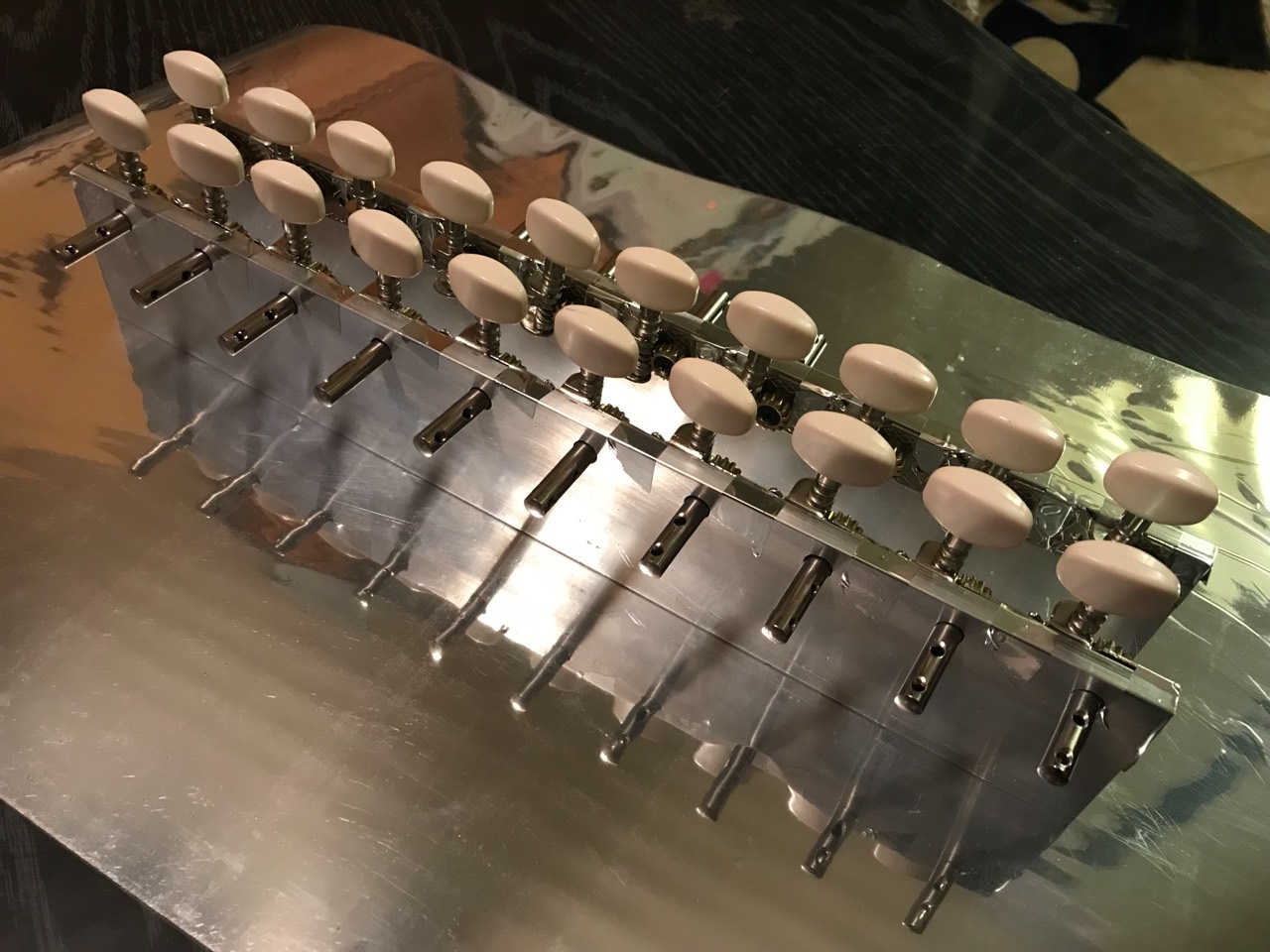
View the limb-segment test-fixture rendering
CAD rendering of the limb-segment actuation test fixture.
Solfugibot’s promise lies in the observations a different kind of reach might make possible. An instrument could approach a layer on a Martian slope, a boulder displaced by a lunar impact, or a deposit among an ocean world’s fractured ice. A shorter route could also leave more of a mission’s time and energy for the investigation itself.
Getting there required the parts to do more for one another: folding and extension served both transport and terrain; shared power kept the moving limbs light; worm gearing supplied motion and helped hold position; different limb designs brought travel and scientific work into one machine. Developing those relationships further could turn a place seen from a distance into a place where an explorer can stop, reach out, and learn.
Robert Salazar
Took on the terrain-navigation challenge and led the team; design and prototyping, including manually extending and articulating limbs.
Aaron Nguyen
Intern; electronically actuated limb development and prototyping.
Savannah Cofer
Intern; worm-drive prototype and large-scale non-actuating mockups.
Adrian Stoica
Group supervisor; proposed the challenge of navigating adverse terrain on other worlds.