
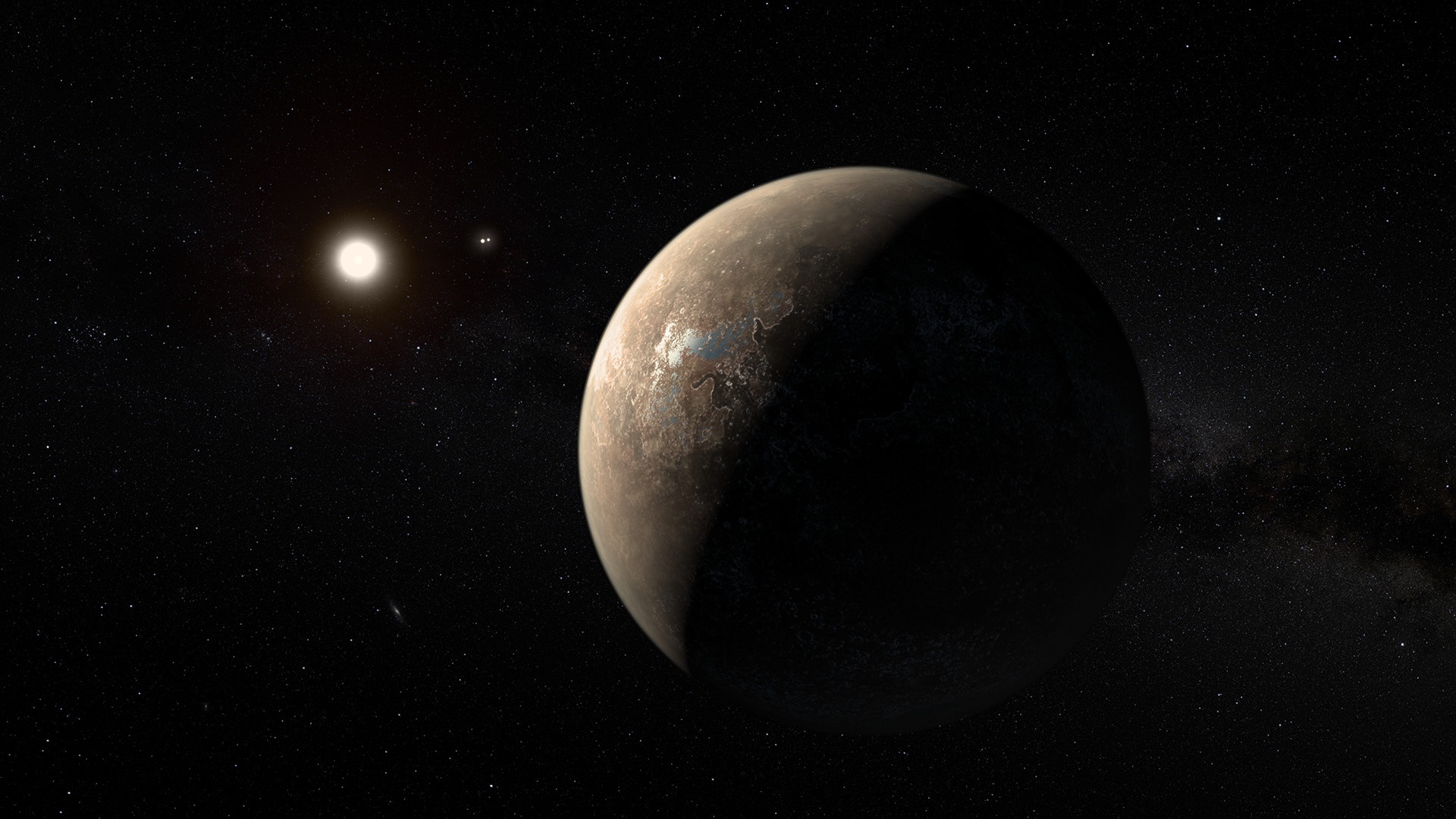
As mysterious as the worlds of our own solar system are, the worlds of other star systems are not only far more mysterious, but also far more numerous. We know little more about them, than their mass, size, and distance from their star. The details about what, if anything, dwells on their surfaces and within their oceans and atmospheres is largely obscured by the blinding intensity of their neighboring star. At the immense distances these exoplanets are, the angular distance between the star and its planets is so minuscule in the night sky, it would be like trying to see a moth flying around a bright light in New York from California. Although space telescopes can allow us to see farther than ever before, the brightness of a star is greatly limiting what we can learn about the worlds that surround it.
As of January 1st, 2021, there are 4,395 confirmed exoplanets in 3,242 star systems, with 720 systems having more than one planet.
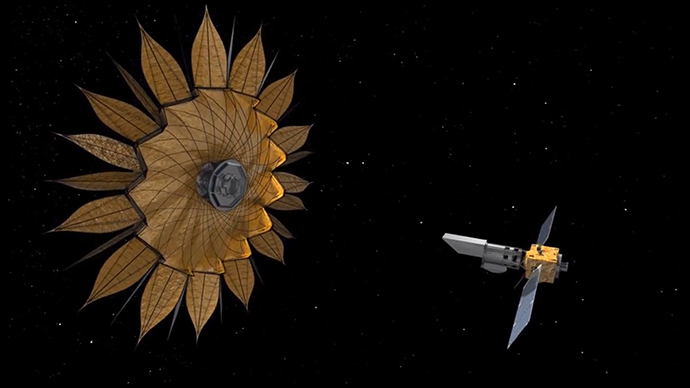
First advanced by Webster Cash at University of Colorado Boulder through the NASA Institute for Advanced Concepts, NIAC, program, was a large occulter that would fly through space with a space telescope, and block starlight from reaching that telescope long enough for it to take direct images of the planets around its star. The large occulter would some day become known as the Starshade and its design would resume at NASA’s Jet Propulsion Laboratory. By directly imaging exoplanets in far greater numbers than ever before possible, the chemical compositions of a great diversity of other worldly atmospheres could be studied. Within those atmospheres, the presence of water, methane, CFCs, and a wealth of other chemical compounds could be detected through their emission spectra and monitored over time. The analysis of these chemical signals would allow for the detection of habitability and even extraterrestrial life.
Video pending restoration.
To prevent any starlight from reaching the space telescope approximately 4 Earth diameters away, it would have to take on a special sunflower shaped perimeter to prevent the diffraction of starlight around its edges and into the space telescope. The Starshade would also have to be very large in order to cover the star at such a great distance from the space telescope. The Starshade’s size and shape would mean that it would need special modifications to fit into the rocket that delivers it to orbit around the Sun. These modifications would ultimately require the Starshade to deploy autonomously in space from a small compact package with an origami folded optical shield surrounding its core.
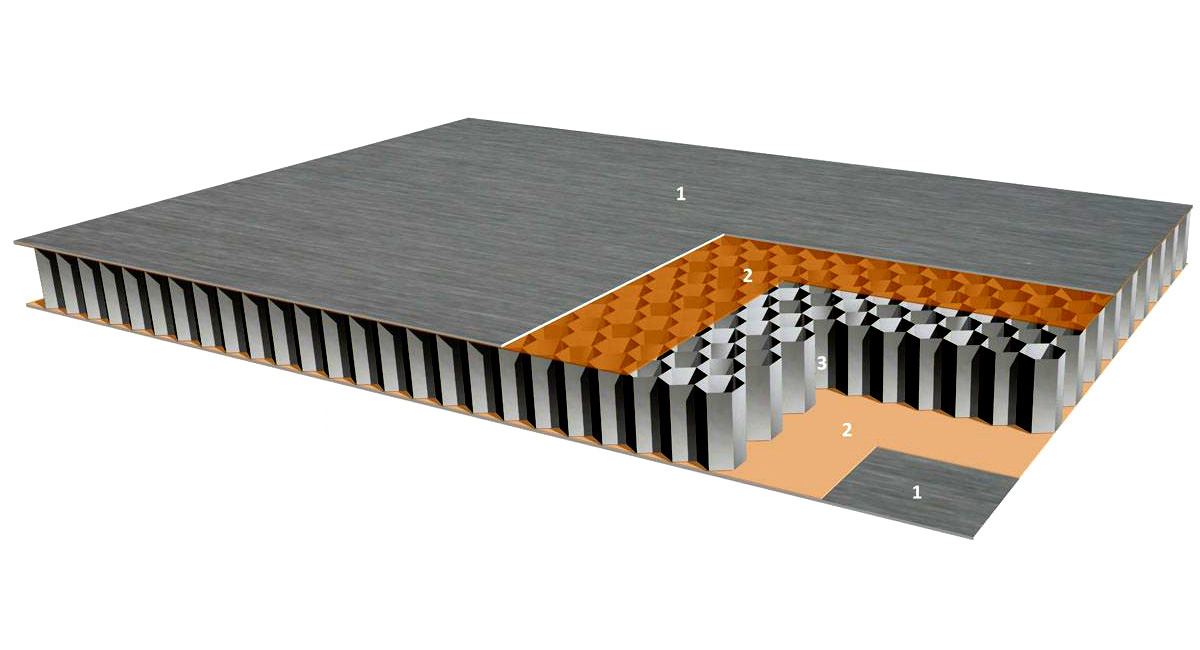
It would take more than an optically designed sun flower shaped perimeter to block starlight however. The Starshade’s starlight blocking central disc, the optical shield, would also need to survive microasteroid strikes to prevent starlight from seeping through. Due to the high kinetic energy density of the microasteroids, absorbing the energy of their impacts over very small randomly located areas on the optical shield would require large amounts of otherwise highly undesirable mass. To mitigate the microasteroid problem in another much less massive way, another solution was proposed. By instead making the Starshade thick, ~1 cm, from a very low density composite material, microasteroids would continue to make holes, but now only holes, really tunnels, from microasteroids traveling perpendicular to the optical shield would allow starlight to pass through, and microsteroids traveling in this exact orientation would be comparatively very rare, allowing the Starshade to persist for many more years of exploration.
The nature of this ultralight composite panel was elusive however. It would require not only minimal density but also be completely opaque, have high stiffness, favorable thermal properties, be biaxially isotropic, and be viable for large scale fabrication. Where honeycomb composite panels are ubiquitous in aerospace for having all of these properties, their hexagonal cell walls would be too thin to bond to the outer face sheets to meet the optical shield’s mass requirements.
This was the new challenge, to design a sandwich-structured composite that would exceed the specific stiffness of honeycomb composites while also being manufacturable at large scale. Overcoming the reduced bonding area intrinsic to ultralight honeycomb was key in designing a solution and origami again became the heart of the invention.
Since the face sheets would each be a polymer film, it was the core of the sandwich-structured composite that would need development. To achieve high stiffness, low density, sufficient bonding area, and to meet the requirements for large scale fabrication, I decided to create the requisite core geometry from a single uncut sheet of polymer film, of the same composition as the face sheets, that could be thermoformed with very little strain. Such a low strain thermoforming process would limit the polymer film to folding alone, to achieve the desired 3D core geometry. Consequently, this single uncut folded polymer sheet would be origami folded, through thermoforming, into a 3D geometry that would serve as the core of the sandwich-structured composite that would make up the Starshade’s optical shield. Since the core would also need to be biaxially isotropic, its geometry would need to have a regular and repeating pattern in two orthogonal directions, in other words a 3D origami tessellation with a crystal system. Biaxial isotropy would also require the geometry of one face of the core to be identical in mechanical properties to the opposite face. For single layer cores this would eliminate tessellations based on hexagonal geometry, since hexagons cannot be alternately tiled evenly. Ultimately, both single layer and double layer cores would be explored, and many hexagonal tessellations would be designed.
The first crystal structure I wanted to design from origami was diamond, due to its extraordinarily high specific stiffness. Such a crystal structure is otherwise known as a face centered cubic bravais lattice with nodes also located within the tetrahedral sites between the octahedrons.
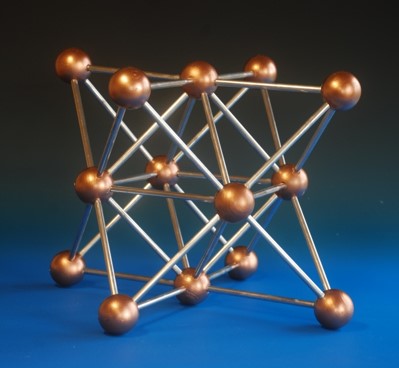
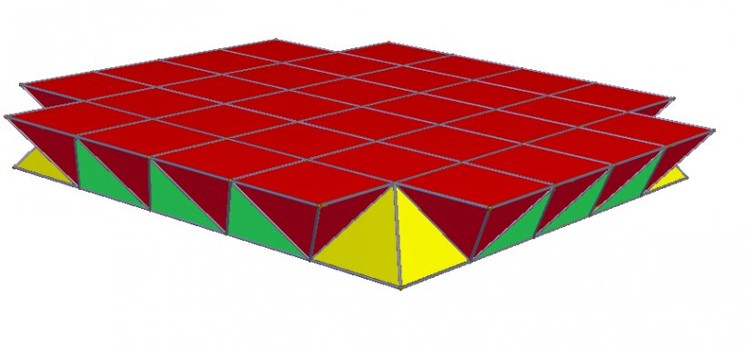
Since diamond’s crystal structure repeats in 3 orthogonal directions, I needed to choose one of the three intersecting layers of carbon atoms as the model for the core of the sandwich-structure composite. Either the layer with the exposed tetrahedral faces, the 111 miller index, or the layer with exposed half-octahedrons, the 001 miller index (the geometry of 2 of the 3 layers is identical). Since the 111 face has equilateral triangular faces, from the tetrahedra, it also has a hexagonal geometry and would be inappropriate for a single layer core due to anisotropy from differing mechanical properties on each side. Proceeding to design a 3D origami tessellation of the 001 miller indexed layer of diamond, I folded my first core prototype and named it Diamond Core.
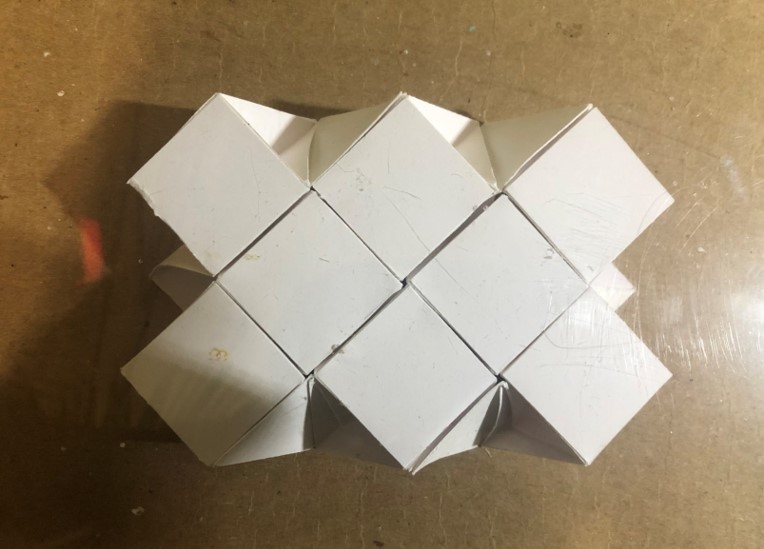
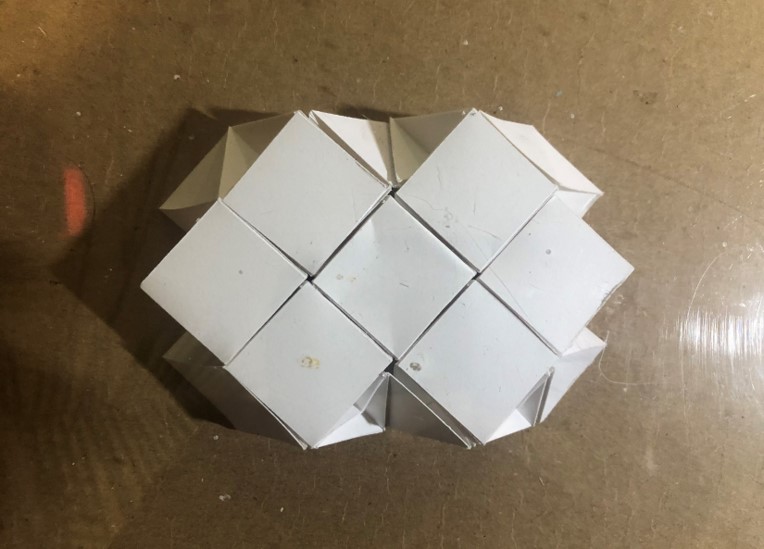
Wherever there was a bond between carbon atoms in diamond there was now a crease with high specific stiffness. Premature testing of Diamond Core showed that it could withstand nearly ten thousand times its own weight in compression without collapsing. Folding Diamond Core from materials with a higher specific stiffness than paper was sure to leads to results that were even more impressive.
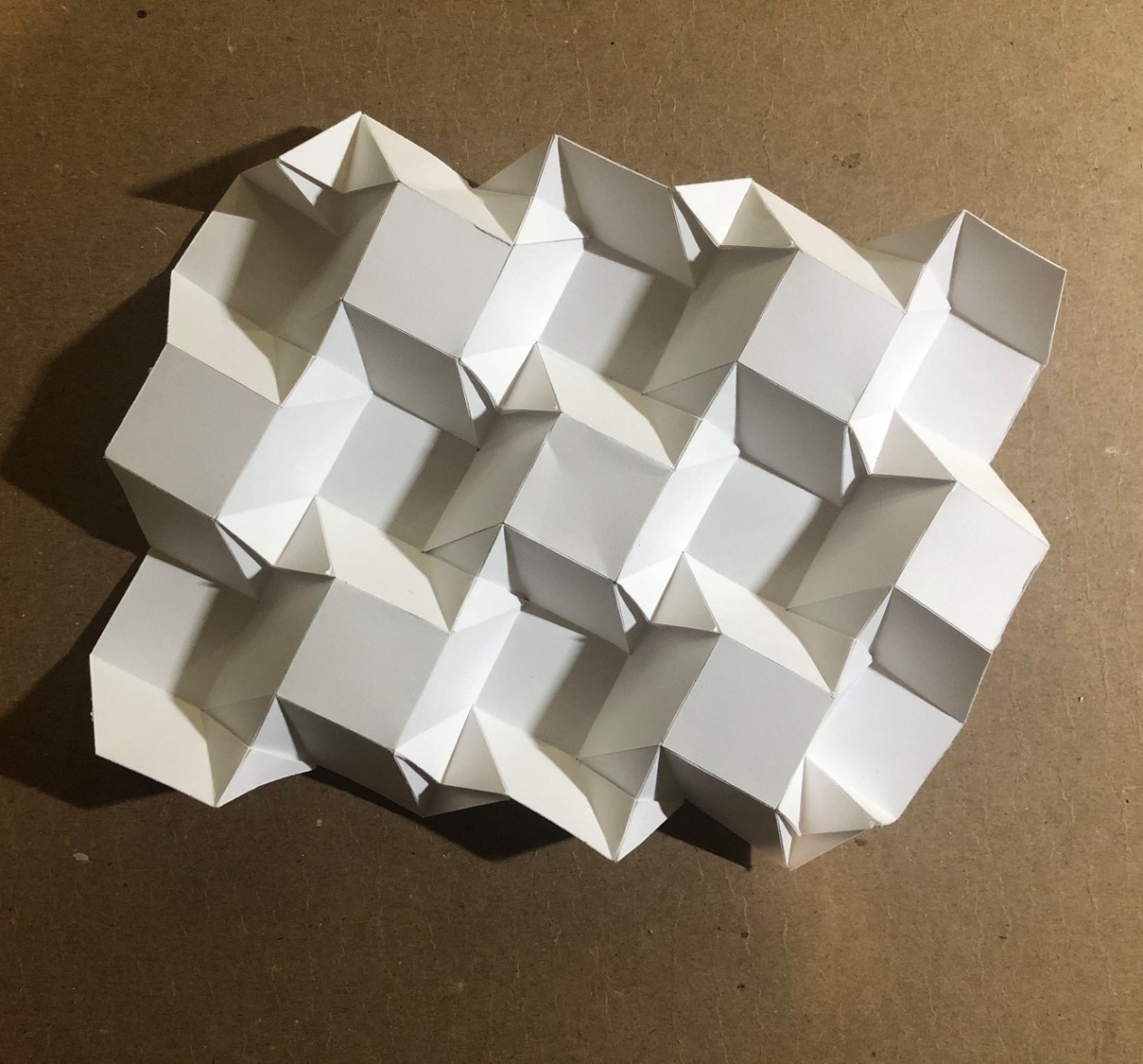
By expanding Diamond Core from the perimeter another core geometry was achieved with the same thickness.