
Folded Art: Origami Animals by Robert Salazar
California Museum of Art and Nature · November 10, 2018

Water can be close at hand and still be unavailable to drink. For someone on an expedition, stranded along a coast, or responding to a disaster, the ability to obtain fresh water can determine what happens next. Orisun began with an ambition to put that capability into a package the size of a water bottle, using sunlight as its source of heat.
Robert Salazar envisioned a tool for survival, backpacking, expeditions and disaster response. It would unfold into a solar collector, concentrate light onto a central chamber, and distill water. Through a succession of prototypes, that idea grew to encompass cooking, dehydration and other uses of solar heat, with one version also supplying electricity. Its usefulness came from the relationships among its parts: the way they folded, supported one another, absorbed and released heat, and served more than one purpose.
Salazar arrived at UC Santa Barbara’s 2017 Startup Weekend with no plan to launch a solar-distiller project. There were two lines: one for people who wanted to start teams, and another for people who wanted to join them. He stood in the second.
“I came to the event for free food,” he recalls.
While waiting, he began thinking about something he already knew how to design: a folding paraboloidal dish. Following his Starshade work, he had generalized his equations to generate crease patterns for rotationally symmetric surfaces, including surfaces with Gaussian curvature such as a paraboloid. The mathematics existed before Orisun. Its application to this solar reflector emerged there in the queue. (Starshade — The Search for Life Among the Stars)
A paraboloid could concentrate sunlight. Concentrated sunlight could supply heat. That heat could distill water. A geometric possibility became the beginning of a practical survival tool.
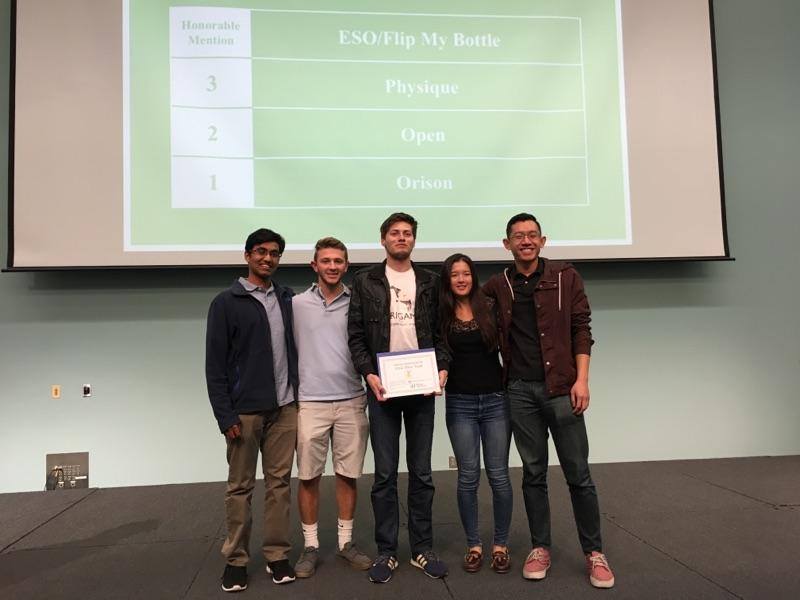
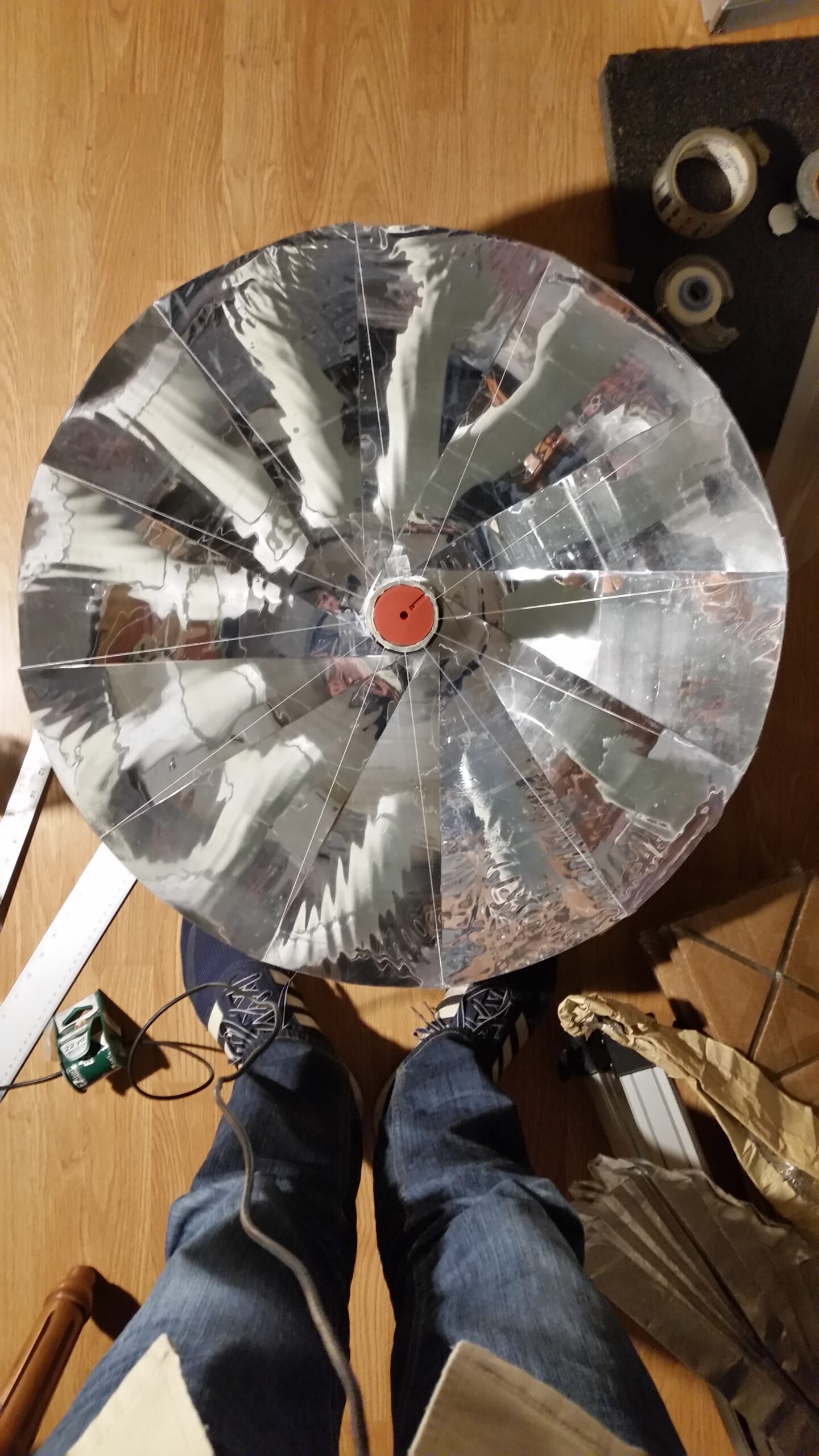
A team formed around the idea. Evan Blasband worked on marketing and presales, while Srikanth Kalluri explored disaster response and the possibility of reaching communities facing potable-water concerns. Isabelle Sato was also part of the team. Salazar built the reflector and used a glass bottle as its central chamber. During the weekend, the setup reached 100°C in 15 minutes.
The outer collection chamber had yet to be built, but the demonstration gave the idea a tangible beginning: sunlight gathered by a folded surface could deliver useful heat to the vessel at its center. The team took first place at Startup Weekend. (The Daily Nexus coverage of Orisun’s competition win)
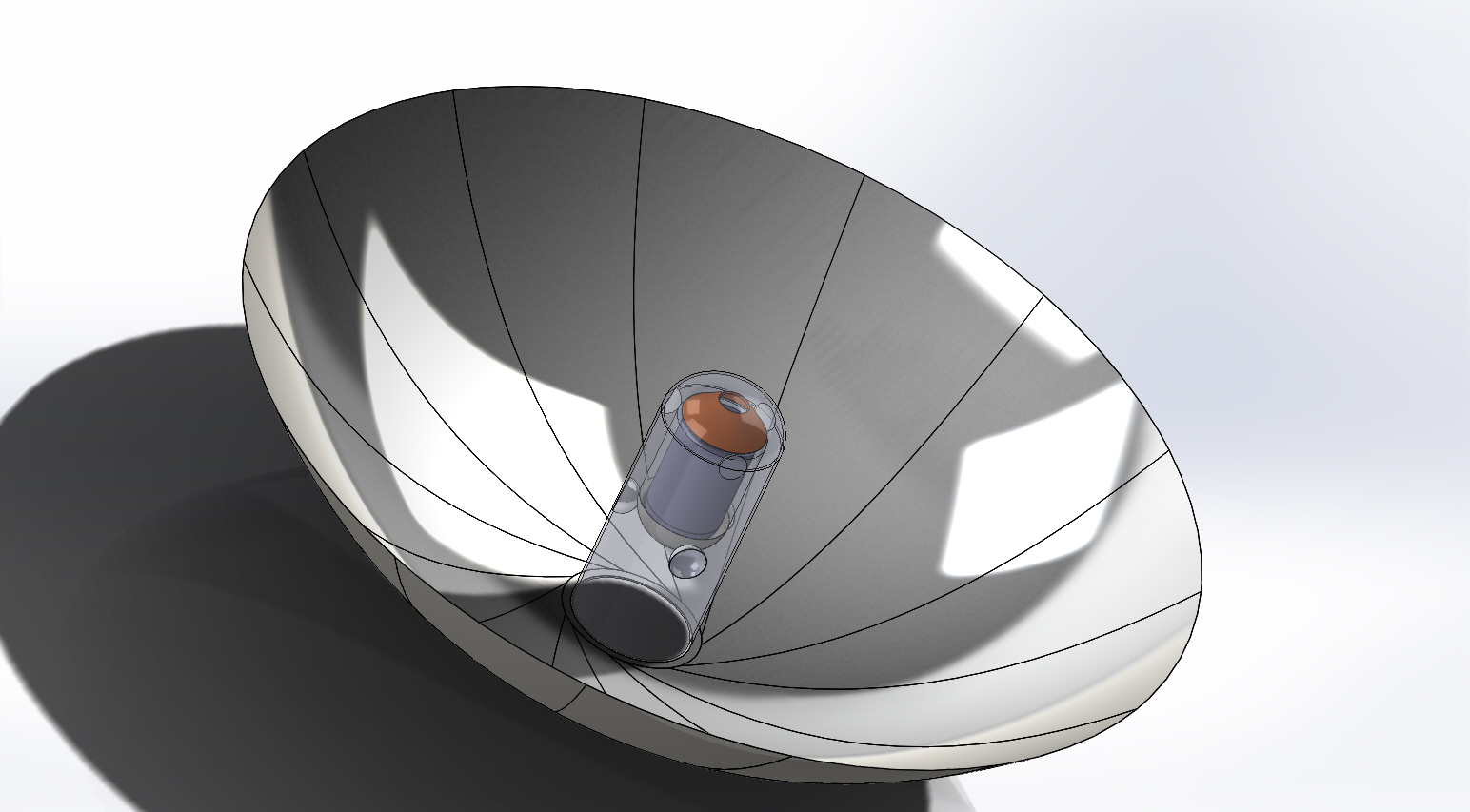
A useful solar collector needs area exposed to the Sun. A useful piece of expedition equipment needs to occupy little space in a pack. Orisun’s folding geometry connected those requirements. The reflector opened into a paraboloid and packed around the central chamber, using an orikaso folded-sheet construction related to Salazar’s Starshade work.
The chamber became both the destination for concentrated sunlight and the center around which the reflector stowed. Its position helped organize the device in both configurations. Opening the folded surface exposed the area needed to gather light; closing it brought that area back around the vessel.
The deployed shape also contributed to its own support. Parts of the reflector tended to lie flat. Holding them in a paraboloidal form introduced stress that made the assembly stiffer, producing a semirigid dish from a surface that could still be folded for storage.
Behind the dish, poles extended outward and upward from a base. Cords connecting their tips flexed the poles, whose restoring force kept the cords under tension. The resulting support depended on the poles and cords acting together. For packing, the poles were removed and included in the bundle.
Material selection served the same practical purpose: reflect sunlight well, remain flexible, and resist scratching and ultraviolet exposure. Salazar worked with suitable materials that were available, using prototypes to develop the device’s form and functions.
Later prototypes completed the distillation cycle.
Source water was heated in the central chamber.
Steam left through its top and passed into an outer chamber, where it condensed and could be collected as distilled water.
These prototypes were also used to distill seawater.
The nested chambers had complementary thermal roles. The inner chamber needed to gain and retain heat; the outer chamber needed to release it so the vapor could become liquid again. Leaving the outer chamber uninsulated allowed it to lose heat to the cooler surroundings.
Further prototypes incorporated a vacuum-insulated inner chamber with a selectively absorbing surface. It absorbed sunlight strongly while emitting relatively little energy as thermal infrared radiation. This combination of high solar absorption and low thermal emission helped the chamber retain the energy delivered by the reflector—the principle behind selective solar absorbers. (NREL on the principles of selective solar absorbers)
Vacuum insulation and the surface’s optical properties addressed different paths by which heat could escape. Together with concentrated sunlight, they made the chamber a capable solar heater. Later prototypes reached heating-chamber temperatures above 300°C within minutes.
The outer chamber acquired another job. More durable than the inner chamber, it protected the absorber as well as collecting distilled water. A component already needed for the process also helped protect the part responsible for gathering and retaining its heat. That sharing of functions mattered in a device whose usefulness depended on how much capability it could carry in very little space.
The heating chamber suggested possibilities beyond desalination. Salazar explored its potential for recovering water from plants, wet sand and contaminated sources, alongside solar cooking, food preservation through dehydration, and sterilization. These applications shared a central resource: useful heat gathered from sunlight in a portable device.
That breadth mattered to the survival-tool concept. A chamber useful for obtaining water could also offer a way to prepare food or dry it for storage. The value lay in how many needs the same hardware could address, reducing the amount of separate equipment a person might otherwise need to carry.
One prototype added a small solar panel above the central chamber, with a USB port for charging. The panel also powered a Peltier cooler—an electrically driven device that helped remove heat from the condensing steam. Solar electricity therefore supported both charging and the distillation process.
Orisun’s development was eventually set aside as Salazar became occupied with other projects. He remains interested in resuming the design. The work left a family of prototypes connecting compact deployment, solar heating, distillation and additional practical uses.
Its origin shows how a capability developed for one purpose can open possibilities elsewhere. Equations extended from the folding of a spacecraft’s optical shield became a means of carrying a solar collector. That collector became the basis for a tool concerned with some of the most immediate needs on Earth: water, food and the ability to keep going.
California Museum of Art and Nature · November 10, 2018


Undergrad Robert Salazar is using his expertise in paper-folding to help NASA create deployable solar reflectors for lunar outposts

Josh Ortiz · The Daily Nexus